


This month, many parents are breathing a sigh of relief as we near the end of the summer camp shuffle. We get a break from the astronomical costs of sending kids to camp (or the stress of keeping them off screens all day when they’re not in camp), finding excuses for skipping out on meetings, not to mention the mileage on our cars, as we settle back into the school routine, which is anything but. Instead of the weekly game of Tetris scheduling, we’re now settling into daily chaos: getting to and from school, lacrosse or soccer practice, piano lessons, tutoring or therapy. Hey, at least it’s predictible, right? Of course, now we move to daily mad rush to the grocery store, putting together a healthy meal, followed by the most dreaded task of all — the battle over homework.
The truth is, it’s hard to keep up with parenting and work — and this isn’t a niche issue. One in three workers in America has a child under 18 (U.S. Bureau of Labor Statistics, as cited in Status of Women in the States, 2015). Despite so many of us struggling with these challenges, most working parents go out of our way to come across as professional and polished even if we’re dying inside, showing up at work each day pretending we have the same capacity as our non-child-rearing colleagues. For years I took great strides to obfuscate my parental responsibilities at work, which I now realize sets a bad example for the teams I’ve led. If I brush off the struggle of raising three kids without ever signaling how it impacts my psyche, what signal does that set for other parents on the team who might be struggling? And what message does it send the non-parents who may not appreciate how challenging it is to raise kids?
The kids (and parents) are not alright
There’s significant evidence that parenting in today’s society is more challenging than it’s ever been: two-thirds of parents say that parenting today is harder than it was 20 years ago (Pew Research Center, 2020). In August 2024, then–U.S. Surgeon General Dr. Vivek Murthy issued an advisory naming rising stress and declining mental health among parents a critical public health issue.
The advisory cited a 2023 American Psychological Association survey finding that 33% of parents reported high levels of stress in the past month, compared with 20% of other adults (Murthy, 2024).
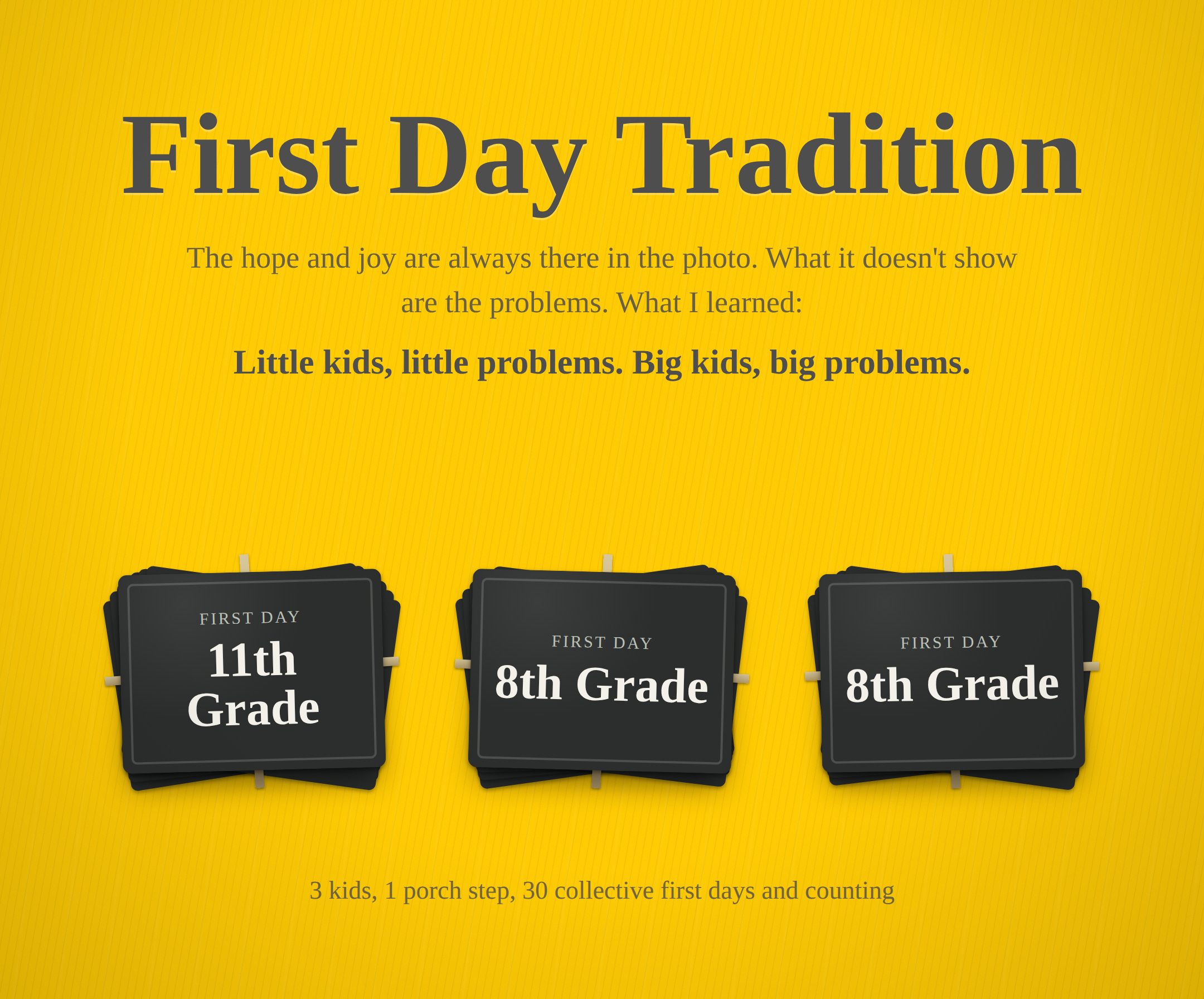
These data hit home for me. I feel the impact of my kids’ struggles as they transition into middle and high school, and I think about the challenges I’ve faced as a working parent that may not be obvious to colleagues without kids, or those just starting their parenting journey. Many assume the early years are hardest, however I had been well prepared by my “sister from another mister,” Dr. Heidi Sallee, an associate professor of pediatrics at St. Louis University, who warned me early in my parenting journey: “Little kids, little problems. Big kids, big problems.”
Over the past sixteen years, Dr. Sallee and I have talked for many hours about the challenges of raising our own kids, and the those she sees in her clinical work in a hospital Adolescent Clinic, where she focuses on teen behavior and mental health. Her kids are more than a decade older than mine, and I’ve always had her on speed dial for parenting problems. “Parenting little kids is physically exhausting,” she once told me, “but big kids are emotionally exhausting.” For parents of middle and high schoolers, the struggle is real right now: adolescent mental health plunged in the early 2010s, with rates of depression, anxiety, self-harm, and suicide more than doubling on most measures (Haidt, 2024), a trend social psychologists such as NYU's Jonathan Haidt have tied to the rise of smartphones and social media (if you're a parent, I strongly recommend you read his book The Anxious Generation and take heed of his advice).
All of this is to say: parents really aren’t okay. And when a kid is struggling, it impacts the parents’ own health and wellbeing and thus their productivity on the job. That’s a workplace problem, not just a home problem.
It’s not fair — for anyone
Before I had kids, I remember a friend and I commiserating about how unfair it felt that we were expected to work until the end of the day, while colleagues with kids got to leave early for daycare pickup. What slackers, we thought. They’re off having fun with their kids while we were the ones doing the heavy lifting.
We didn’t appreciate what our colleagues were actually going through: hours of work after their kids went to bed, sheer exhaustion, output that never actually dropped. We were annoyed that we had to work around someone else’s schedule — even though no one extended us the same grace to our own lifestyles (i.e., we were still expected at our desks from 8am until 5pm, no matter how many margaritas we had the night before).
It’s frustrating for people without kids to watch colleagues receive benefits they don’t have access to, such as paid family leave, child care, and “take your child to work day.” None of these benefits mean much for the 2/3s of workers who aren’t raising families and it can lead to resentment and real tension between those with kids and those without.
That tension can mean the difference between a family-friendly policy that actually works and one that breeds quiet resentment.
What the research tells us: supervisor & collegial support
Organizations understand that supporting familial responsibilities has a significant impact on employee performance, which is why more and more research into work-family conflict is coming out of the I/O psych community. A 2011 meta-analysis (that’s academic speak for a study summarizing a bunch of other academic studies) by Shockley and Singla found that work-to-family interactions are highly associated with job satisfaction. In a more recent 2025 meta-analysis, Blom et al. found that caregiver support from organizations has a real, measurable impact on the bottom line: family-friendly policies are positively associated with employees’ intent to stay, their perceived career success, and their overall health and wellbeing. As a result, organizations are starting to increase benefits to help, which is a great start.
But benefits and policies are really just a starting point. A critical and often undervalued piece of the puzzle is the culture, which centers around supervisor and co-worker support. In my psychometrics course this summer, my professor Leanne Tortez introduced us to her Family-Supportive Coworker Behavior (FSCB) Scale, which measures the extent to which employees perceive their coworkers as willing to actively support their work-family balance (Tortez & Mills, 2022).
The research is clear on what’s at stake. Collegial support is linked to decreased psychological strain, depression, stress, burnout, and turnover as well as increased wellbeing, job performance, job satisfaction, commitment, and work-family cohesion (Tortez & Mills, 2022). Similar findings hold for supervisor support. But if supervisors or peers carry resentment toward colleagues managing caregiving responsibilities, the reverse is just as possible. That’s bad for the organization, and it’s exactly why family-friendly policies can’t stand alone, they must be backed by a culture that genuinely supports family responsibilities.
The question is: how can you tell whether supervisors or teams are actually supporting colleagues? It starts with understanding. Validated survey instruments such as Professor Tortez’s FSCB scale and Hammer et al.’s (2013) Family Supportive Supervisor Behavior Short-Form (FSSB-SF)* can help organizations assess that support directly.
Once you have a sense on where things stand, you can deploy interventions to address the gaps.
For example:
Gatherings for all. A family-friendly event where colleagues can meet each other’s kids and see how cute — and how challenging — they really are does more for culture than “take your child to work day” alone, which tends to draw only the parents of little kids. Family events need to feel worthwhile for everyone, from babies to teens to colleagues without kids at all.
Making benefits more equitable. As my own kids aged out of day care, I lost the need for many of the benefits built around it — but I was glad to see changes to my employers’ benefits policies that started to extend to older kids. Day care credits that can flex toward tutoring, elder care, or pet care. Fertility treatment coverage is becoming more common. Parenting inclusion networks are great but exclusionary. Supporting opportunities for young people to gather, reduces resentment toward parents because all workers feel they have a fair set of benefits.
Leaders setting examples. The reality is I don’t know a parent out there who doesn’t struggle with parenting. And yet, these conversations mostly stay behind the scenes in a hushed “parent to parent” safe space and thus our non-parental colleagues have no clue how challenging it is to parent. How often do senior executives talk openly about their kids’ existence, much less their struggles? Is it because a nanny or a stay-at-home spouse is quietly managing it all, or because they simply don’t want to appear weak? The stories we do hear tend to be the highlight-reel version showing how much fun they’re having — leaders posting about a Taylor Swift concert with their kid, not the nightmare it involved getting the family through flights and hotels and traffic jams getting there.
The bottom line
In a nutshell, the key to building a successful family-supportive environment is more about building culture that supports ALL families (kids or not) than it is about benefits. Understanding whether you have a problem in the first place is an important first step and there are great tools to measure this. Once you know where you stand from a culture standpoint, only then can you take effective action to make this a great school year for everyone at the company.
Reading the research on scales like the FSCB or FSSB-SF isn’t always intuitive — it took me all summer to get comfortable with it. If you want help interpreting or accessing the research (which may be locked behind academic firewalls), DM me and I’d be happy to walk you through it.
References
Blom, R., Jaspers, E., Knies, E., & Van Der Lippe, T. (2025). Family-friendly policies and workplace supports: A meta-analysis of their effects on career, job, and work-family outcomes. Journal of Vocational Behavior, 157, 104091. https://doi.org/10.1016/j.jvb.2025.104091
Hammer, L. B., Ernst Kossek, E., Bodner, T., & Crain, T. (2013). Measurement development and validation of the Family Supportive Supervisor Behavior Short-Form (FSSB-SF). Journal of Occupational Health Psychology, 18(3), 285–296. https://doi.org/10.1037/a0032612
Murthy, V. H. (2024). Parents under pressure: The U.S. Surgeon General’s advisory on the mental health and well-being of parents. U.S. Department of Health and Human Services. https://www.hhs.gov/surgeongeneral/priorities/parents/index.html
Pew Research Center. (2020). Parents’ attitudes — and experiences — related to digital technology. https://www.pewresearch.org/internet/2020/07/28/parents-attitudes-and-experiences-related-to-digital-technology/
Shockley, K. M., & Singla, N. (2011). Reconsidering work—family interactions and satisfaction: A meta-analysis. Journal of Management, 37(3), 861–886. https://doi.org/10.1177/0149206310394864
Status of Women in the States. (2015). Work & family. Institute for Women’s Policy Research. https://statusofwomendata.org/explore-the-data/work-family/
Tortez, L. M., & Mills, M. J. (2022). In good company? Development and validation of the Family-Supportive Coworker Behavior Scale. Journal of Vocational Behavior, 136, 103724. https://doi.org/10.1016/j.jvb.2022.103724