


A year ago, I was feeling a real sense of burnout. As a mom of three extremely active adolescents juggling a full-time job in constant flux (I mean aren’t we all still figuring out what AI means for our business models?), and generally crazy world, I was burned out at work and burned out at home. I struggled to get out of bed each morning and craved the moment I could collapse back into it and watch something mindless on Netflix. My workout routine was just that: routine. No goals, no desired outcomes.
I was going through the motions on all fronts.
Then one day, I got curious about an organizational challenge I was facing at work — and my world changed. After falling down a research rabbit hole, I discovered a genuine passion for organizational behavior and psychology, and before I knew it, I was enrolled in a summer statistics course at Harvard, jumping out of bed at 5 a.m. to study until the wee hours. All while staying on top of work and those pesky teenagers and with a much more intentional workout routine in place.
How did adding a massive new responsibility to my plate actually reduce my burnout?
Because burnout isn’t about how much you work. It’s about your relationship to the work itself.
Burnout is described as “a condition that occurs when employees become so stressed that they experience emotional exhaustion, depersonalization, and a sense of reduced personal accomplishment” (Levy, 2025). It shows up as decreased motivation, cognitive weariness, lack of energy, and physical fatigue. And the stakes are not just personal. Workplace stress is linked to serious physical conditions including heart disease, which the CDC identifies as the leading cause of disability in the U.S. workforce — costing companies roughly $240 billion per year in healthcare, medication, and lost productivity.
So how do we get there? And more importantly — how do we get out?
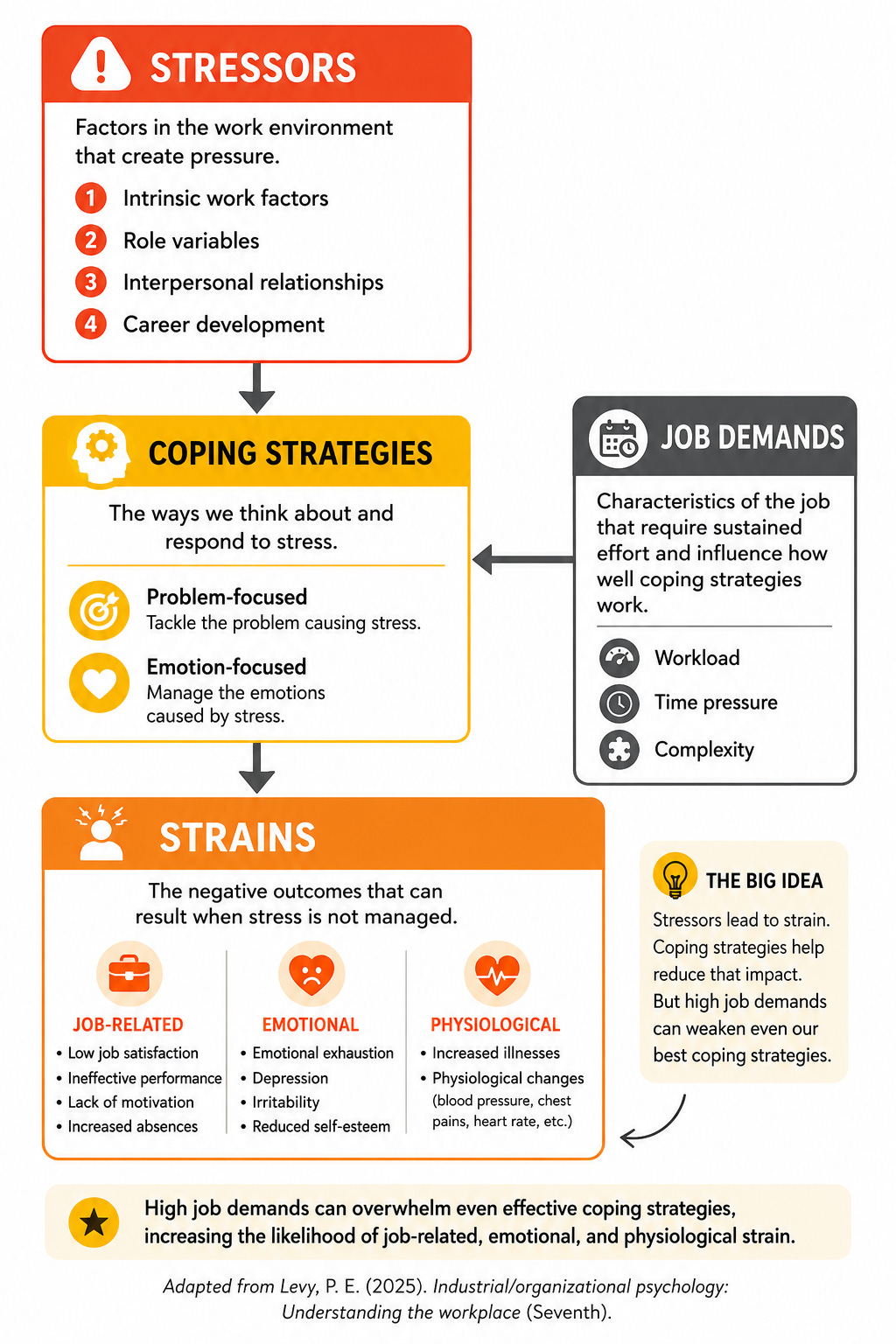
While our jobs generate real stressors, how we face them is largely within our control. In the I/O world, we have specific definitions related to burnout worth understanding:
Stressor: Any seriously disruptive event, situation, condition, or person that can be a source of physical, mental, or emotional strain and stress for an individual.
Strain: Undesirable personal outcomes resulting from the experience of stressors.
How individuals respond to stressors impacts the likelihood that stress will lead to strain. Numerous studies have shown that individuals with high levels of strain are more likely to be disengaged or burned out, and to have high turnover intentions — planning to quit quietly or leave the company altogether. In extreme situations, it may lead to self harm or workplace violence (believe it our not the term “going postal” is in the I/O textbooks as toxic work climates contribute to mental health decline of workers).
Below is an adaptation of the key model from a leading I/O Psychology textbook that brings this concept to life. Organizational psychologist have ample evidence showing the negative impact of piling stressors and strains onto workers, and strongly suggest that finding ways to reduce stress and offer coping mechanisms isn’t just nice to have. It’s a business essential.
Turning to clinical psychology for coping mechanisms
Although I’m a budding organizational psychologist and not a clinical therapist, our field draws heavily on core psychology frameworks to help organizations reduce employee strain and burnout. I should preface this recommendation with the fact that if things are really bad, getting help from a licensed therapist is essential — and there are many affordable online services available these days — but if things are still manageable, here’s a tool to help dial it down, drawing from the Cognitive Behavioral Therapy Thought Record template (Nick, 2025).
Here’s a situation most of us have lived: your boss sends a Slack message at 6 p.m. — no greeting, no context — “Can we talk about the timeline tomorrow?”
You know the project is behind. And the spiral begins. You lay in bed thinking: We’re not going to make it. If we don’t make it, that’s on me. If that’s on me, I’m gone. If I’m gone in this economy … Next thing you know, you’re three steps from selling your house and living in your car before the sun comes up.
What if, instead of catastrophizing, you try out this Thought Record exercise to reframe the problem? Here’s how it might look in practice.
Thought Record example
Situation: Where were you? What were you doing? Who were you with?
My project is behind schedule. My boss sent a Slack message at 6 p.m. asking to “talk about the timeline.” I’ve been in bed for two hours not sleeping.
Automatic Thought: What went through your mind?
I’m a failure. We’re not going to hit the deadline. Even if I worked 18-hour days it still wouldn’t matter. We’re dependent on two other teams who aren’t nearly ready, and no amount of personal heroics fixes that.
Emotions: What did you feel? Rate intensity 0–100.
Stressed. Completely, physically stressed — chest tight, jaw aching, teeth clenched for three hours. 95%.
Cognitive Distortions: Identify the thinking traps.
If I fail this deadline, they’re going to fire me. If they fire me in this economy, I’ll never find another job. If I can’t find another job, I’ll have to sell the house. And if I sell the house, the kids won’t be able to go to college…
NOTE: At this juncture, you need to stop yourself before you’re living in your car. This is known as catastrophizing, fortune-telling, and all-or-nothing thinking. Name it — then move on.
Evidence FOR the thought: What actually supports this?
There have been real layoffs. People I respect, people who were good at their jobs, got cut. A few were unemployed for over a year. The economy isn’t making this easier. Those are facts.
Evidence AGAINST the thought: What contradicts it?
I’ve survived three rounds of layoffs — not because I got lucky, but because I’m a top performer and leadership knows it. And those friends who were laid off? They found jobs. They still have their houses. Their kids are fine. The worst version of the story I’m telling myself hasn’t actually happened to anyone I know.
Balanced Thought / Reframe: What’s a more realistic, balanced view?
I’ve done the best I can with what I was handed. The delay isn’t a character flaw — it’s a resourcing problem, and there’s a difference. What I actually need to do is walk my boss through the dependency map so she understands this isn’t a performance issue. She’s a reasonable person. She can handle a hard conversation if I come in with the facts.
New Emotion Rating:
Stress: 55%.
See what you did there? The stress is not gone — not even close. The project is still behind. The Slack message is still sitting there. The meeting is still tomorrow.
But 55% stressed is not 95%. And 55% is something you can sleep through.
Exercises like this don’t eliminate the problem. But they are great coping mechanisms to help redirect your energy toward what you can actually control — and away from the stories your brain tells at midnight that bear little resemblance to reality.
That’s the shift that made the difference for me. The stress of work, kids, and the economy isn’t going away. But fixating on what I can’t change is just expensive — it costs time, sleep, and bandwidth I’d rather spend elsewhere (such as taking classes and writing Substack articles translating I/O Psych concepts into layman terms).
One more thing worth noting for anyone in a leadership role: managers are often the first line of defense against team burnout. If you notice someone spiraling, this kind of reframing tool isn’t just for your own use. It’s something you can offer strugging team members.
Sources
Levy, P. E. (2025). Industrial/organizational psychology: Understanding the workplace (Seventh). Worth Publishers, Macmillan Learning.
Nick, E. (2025, September 11). ChoosingTherapy.com. Thought Record CBT Worksheets. https://www.choosingtherapy.com/therapy-worksheets/thought-record/