


Last week I introduced the most commonly cited paths to leadership in the research, and told you about two leaders I’ve worked with who both fit the mold — one an exemplary leader, the other far less so. Given that there are several non-merit-based paths to leadership, we need to understand what happens when people lacking key leadership knowledge, skills, and abilities reach those roles anyway.
There are a myriad of reasons why some people who reach leadership ranks excel while others fail to rise to the occasion, but I want to zero in on one cognitive bias that trips up leaders if they’re not careful: the Dunning-Kruger Effect, or “DKE” for short.
What DKE Isn’t
A lot has been written about DKE — and a lot of it is a convoluted or distorted version of the actual research. Here are a few misinterpretations I’ve run into recently:
“Bad performers wildly overestimate themselves, good performers are more accurate (and often underestimate).” (AI slop.)
“Dumb people overestimate their intelligence.”
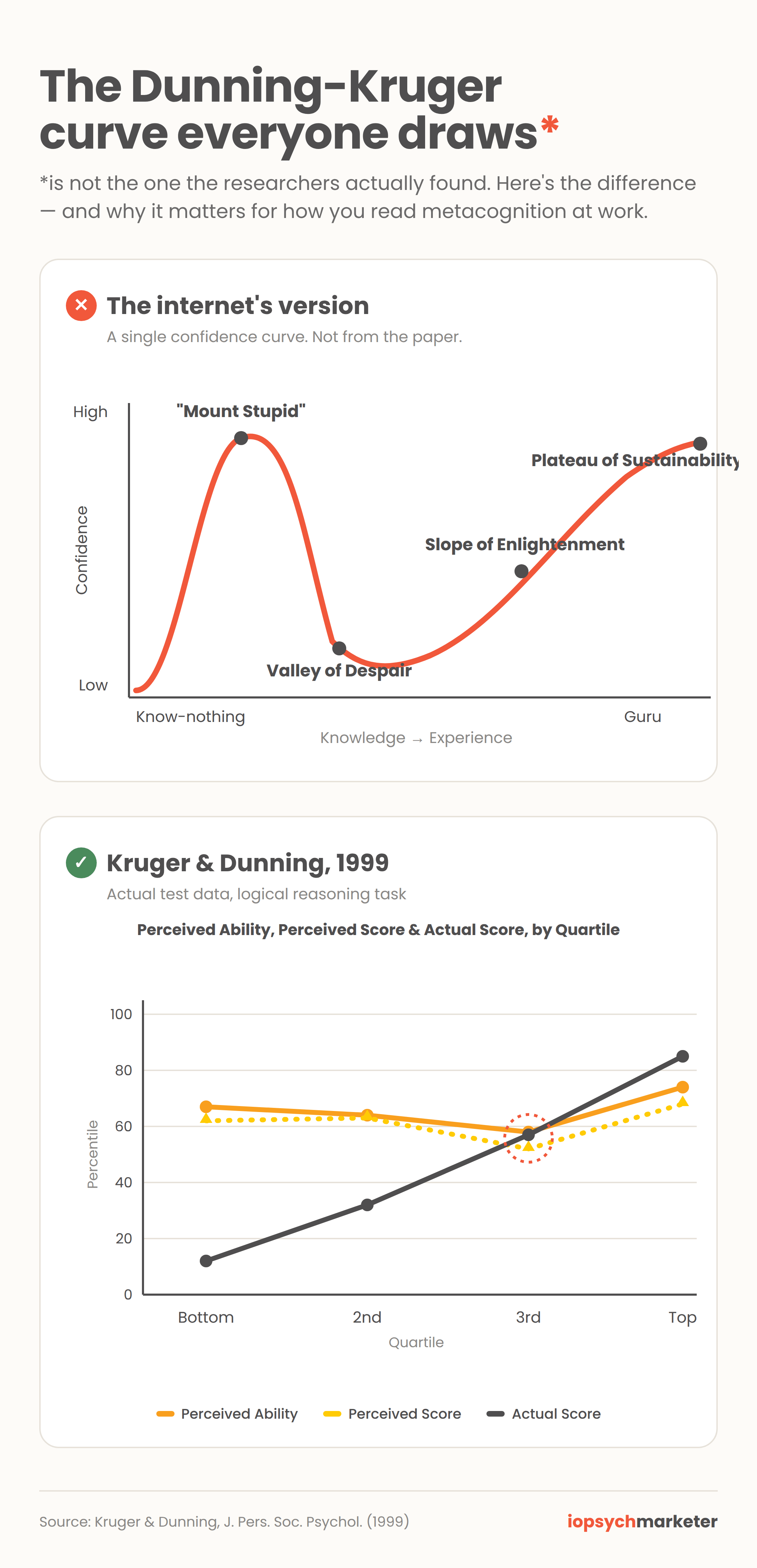
And whoever came up with the “Peak of Mount Stupid” vs. “Valley of Despair” (see image) chart never actually read the research. Cute gimmick. Tenuous connection to the data at best.
What DKE Really Is
So now we know what DKE isn’t — what is it, really? Let’s go back to the original 1999 research. Justin Kruger and David Dunning at Cornell titled their study “Unskilled and Unaware of It” — a title that says a lot on its own. They found that people with the lowest skills tend to overestimate their performance, people with moderate expertise are more accurate, and people with the highest expertise often underestimate their performance.
The concept underneath all of this is metacognition, which Kruger and Dunning define as “the ability to know how well one is performing, when one is likely to be accurate in judgment, and when one is likely to be in error” (Kruger & Dunning, 1999, p. 1121).
There’s no indication in the research that individuals exhibiting DKE are low performers, feel stupid or have any sense of despair about their expertise. It’s simply that they don’t have a good read on their own ability relative to everyone else’s.
Here’s the example I like to use: the difference between my husband’s and my own perception of our analytical skills.
Me: business and marketing leader (and emerging I/O psychologist), decent amount of dabbling in data and analytics over the years. I can do some mean pivot tables in Excel, pull data out of operational systems with the best of them, and I’m confident in my ability to coach teams on building snazzy data-driven powerpoint decks with insightful analysis.
Eric (my husband): math major, shelf full of statistics books, advanced data science coursework at Stanford and Northwestern, 20-plus years working as a data scientist exploring massive data sets at a major bank. The guy knows his stuff!
When I once suggested he was probably one of the top data scientists in the business, he pushed back hard: “No, there are so many people out there with PhDs building really sophisticated models and packages who know way more than I do.” He has enough expertise to know exactly how much more expertise exists. I, on the other hand, had always assumed I was above average in the data and analytics space — which was true, but only compared to people outside that field. It wasn’t until I was getting coached through running stats models in R Studio by my 19-year-old Harvard teaching fellow that I realized how basic my analytic skills actually were. Good for a marketer perhaps, but in the grand scheme of things, I have a heck of a lot to learn.
So we’re both subject to DKE bias — while I certainly have been overestimating my skills, I’d argue that Eric underestimates his. He may not be the top 1% of data scientists, but he’s certainly in the top 10% of data scientists — and top 1% of the general population.
This is the asymmetry at the heart of the effect: the same lack of expertise that makes it hard to do something well also makes it hard to judge how well you’re doing it. Novices don’t have the knowledge to spot the gaps in their own performance, so their confidence floats free of their actual skill. Experts have the opposite problem — they know the field well enough to see exactly how much more there is to know, so their confidence gets dragged down by a realistic view of everyone ahead of them.
DKE in Decision-Making
Researchers have looked at how DKE shows up specifically in leadership and decision-making — which was the focus of my paper. One of the most interesting studies I found was by Nold and Michel (2023), which found that people with inflated views of their own abilities, once they’re in positions of authority, will make decisions even when they’re (a) ignorant of the subject matter, (b) unaware of important circumstances, or (c) acting like experts when they aren’t. In other words: leaders exhibiting DKE often just wing it, even when they have no idea what they’re talking about. Nold and Michel go further, arguing that this overconfidence damages a leader’s ability to evaluate their team’s performance and shapes their critical thinking and decision-making in ways that hurt the whole organization.
Christopher et al. (2023) looked at DKE alongside high self-efficacy and narcissistic (defined as a lack of empathy plus inflated entitlement, grandiosity, and self-importance) tendencies. They found that people with narcissistic or high-self-efficacy tendencies do tend to overestimate their abilities, though there’s some debate about whether they’re actually unaware of their skill gaps or just unwilling to admit them.
The researchers also found that DKE was negatively associated with hypervigilance in decision-making. In layman’s terms: narcissistic leaders rely on their own gut over facts or outside information, and are more likely to make impulsive calls driven by a positive self-view. They tend to undervalue other people’s suggestions rather than confront their own gaps. Interestingly, DKE was also negatively correlated with decision-avoidance, buck-passing, procrastination, and rationalization. So while the instinctual, overconfident decision-making of a DKE leader can produce bad outcomes, there’s can be an upside: decisiveness and the ability to move fast.
So What?
How does this play out inside organizations? When leaders exhibiting DKE skip consulting experts because they’re too confident in their own read, decision quality drops. Nold and Michel (2023) found that when executives overestimate their own abilities and underestimate their team’s, trust erodes — and that erosion directly hurts organizational agility. Pair that with the impulsive, fact-averse decision-making Christopher et al. describe, and you’ve got the exact recipe behind the corporate scandals and AI-implementation failures I mentioned in the last post.
So to set the record straigh, DKE isn’t really about intelligence. It’s about calibration. The people who should have the most confidence — the deep experts — often have the least, because expertise is what makes you aware of everything you still don’t know. Often, the people you should be listening to sound the least sure of themselves. The ones radiating the most confidence are exactly the ones worth a second look.
None of this gets fixed by hoping people become self-aware on their own. Next week: what the research says on how to reduce DKE in leadership ranks.
Resources
Bonner, B. L., Baumann, M. R., & Dalal, R. S. (2002). The effects of member expertise on group decision-making and performance. Organizational Behavior and Human Decision Processes, 88(2), 719–736. https://doi.org/10.1016/S0749-5978(02)00010-9
Christopher, K. I., Padmakumari, P., & Herbert, H. S. (2023). Presence or absence of Dunning-Kruger effect: Differences in narcissism, general self-efficacy and decision-making styles in young adults. Current Psychology, 42(2), 1444–1455. https://doi.org/10.1007/s12144-021-01461-9
Kruger, J., & Dunning, D. (1999). Unskilled and unaware of It: how difficulties in recognizing one’s own incompetence lead to inflated self-assessments. Journal of Personality and Social Psychology, 77(6), 1121–1134.
Nold, H., & Michel, L. (2023). The Dunning-Kruger effect on organizational agility. In V. Bobek & T. Horvat (Eds.), Business, Management and Economics (Vol. 13). IntechOpen. https://doi.org/10.5772/intechopen.113827