


For my intro I/O Psych class, we had to write a 10-page paper on a topic of our choosing. I picked the cognitive bias called the Dunning-Kruger Effect — specifically, how it shows up in leadership ranks. You know the one, it’s where the least competent people are the most confident, and the most competent people underestimate their levels of expertise.
I got a little carried away. The assignment called for 7 sources. I read over 50, because every paper I opened led me to three more, much to the dismay of my family after hearing me pontificate on the subject over dinner for 2 months straight. But the rabbit hole was worth it, because it answered a question I’ve asked myself frequently over the course of my whole career: why are so many people in leadership positions so darn bad at leading?
A lot of this comes down to what happens once someone influenced Dunning-Kruger is in a leadership position. But first, we need to talk about something more basic: how do people get into leadership roles in the first place? Spoiler — it’s often not because they are good leaders.
The Path to Power
(Not Paved With What You’d Hope)
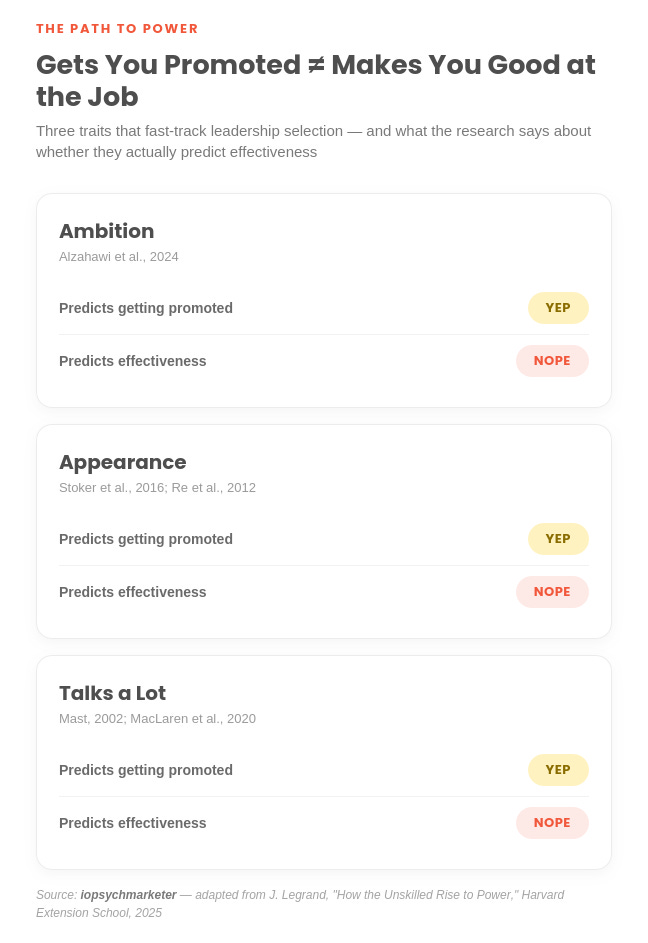
What I uncovered in the research is that the traits that get you promoted into leadership and the traits that make you good at leadership barely overlap. Three in particular keep showing up as fast-tracks to the corner office, with approximately zero correlation to whether you should actually be sitting in it.
1. Ambition
Ambition — “a persistent and generalized striving for success, attainment, and accomplishment,” per Alzahawi et al. (2024) — is one of the strongest predictors of who reaches senior leadership. Makes sense on its face: ambitious people chase the fancy degrees, work the longer hours, angle for the visibility. What doesn’t make sense is what happens next. Ambitious leaders rate themselves as effective. Nobody else does. Side note: I resisted the temptation of digging deep into the overlap between ambition and narcissism, but the literature is filled with research on the topic. I’ll just leave it at that (for now).
In fact, Alzahawi and colleagues found zero evidence that ambition predicts third-party ratings of leadership effectiveness. So the drive that gets someone the job tells you nothing about whether they’ll be any good at it — it just tells you they wanted it badly enough to get it.
2. Appearance
Yes, really. Multiple studies have found that how a candidate looks predicts whether they get picked to lead — and tells you nothing about whether they can. Stoker et al. (2016) found facial structure strongly predicts who gets selected as a CEO, with no relationship to actual performance. Re et al. (2012) went further, finding that perceived height, facial maturity, and a “healthy” BMI all correlated with higher leadership ratings from observers who had no information about how these people actually led. Nobody’s abilities were assessed. Just their faces. We like to think we’ve evolved past picking leaders like we’re casting a movie. We have not.
3. Talking a Lot
Unfortunately for the strong, quiet types, I’ve got bad news, but research into the “babble hypothesis” found that the person who talks the most in a room gets perceived as the most dominant and the most leader-like — regardless of whether what they’re saying is any good. Marianne Schmid Mast’s landmark 2002 meta-analysis found a strong relationship (r = .55–.60) between how much airtime someone took up and how much leadership ability observers assigned them. The effect was even stronger for men than women. And in case you were hoping this got debunked over time — MacLaren et al. (2020) ran it back in 2020 and confirmed it: talk time predicts who emerges as the leader, independent of whether the talking was useful. It’s sad to say that quantity beats quality, but if you really want to move up in the world, it’s time to start speaking up more.
So What Do We Do With This?
I don’t know about you, but I’ve always wondered why so many good-looking blowhards end up leading teams they shouldn’t, and the quiet, supportive leaders keep getting passed over for promotion.
Turns out it’s not a misperception — it’s a documented pattern. Not that this means ambitious, attractive, talkative people can’t be great leaders. Plenty are. The point is that none of those three traits are why — and organizations that keep hiring and promoting for them instead of for actual leadership capability are, whether they realize it or not, running a selection process optimized for confidence, not competence.
What happens once one of these unqualified leaders is actually in charge — it’s often not pretty.
We only need to look at the famous stories such as Enron, Wells Fargo, Lehman Brothers, WeWork, Theranos to remind ourselves of some truly spectacular disasters from seemingly competent leaders. One might argue these were ethical challenges, but strip away the fraud and greed headlines and you find the same thing underneath: leaders who rejected expertise because they were too confident to think they needed it. And before you file this under “history,” consider that 95% of AI pilots are currently failing to hit their goals while companies quietly lay off the humans who could’ve told them that (Challapally et al., 2025).
Overconfidence in isn't a 2008 problem. It's a right-now problem, particularly when folks are leading AI initiatives. Tune into my next post where I'll dig deep into what happens when leaders succumb to the Dunning-Kruger effect.
Sources
Alzahawi, S., Reit, E. S., & Flynn, F. J. (2024). A legend in one’s own mind: the link between ambition and leadership evaluations. PNAS Nexus, 3(8). https://academic.oup.com/pnasnexus/article/3/8/pgae295/7736721
Challapally, A., Pease, C., & Raskar, R. (2025). The GenAI divide—State of AI in business 2025 [White paper]. MIT NANDA. https://www.aigl.blog/state-of-ai-in-business-2025/
Henderson, A. A., Matthews, R. A., McKersie, S. J., & Whitman, M. V. (2022). Leading when overweight: The influence of supervisor body weight on subordinates’ perceptions and citizenship behaviors. Journal of Business and Psychology, 37(3), 615–631. https://doi.org/10.1007/s10869-021-09763-2
Mast, M. S. (2002). Dominance as expressed and inferred through speaking time: a meta-analysis. Human Communication Research, 28(3), 420–450. https://doi.org/10.1111/j.1468-2958.2002.tb00814.x
MacLaren, N. G., Yammarino, F. J., Dionne, S. D., Sayama, H., Mumford, M. D., Connelly, S., Martin, R. W., Mulhearn, T. J., Todd, E. M., Kulkarni, A., Cao, Y., & Ruark, G. A. (2020). Testing the babble hypothesis: Speaking time predicts leader emergence in small groups. The Leadership Quarterly, 31(5), 101409. https://doi.org/10.1016/j.leaqua.2020.101409
Nichols, T. (2024). The death of expertise: The campaign against established knowledge and why it matters (Second edition, Updated and expanded edition). Oxford University Press. https://doi.org/10.1093/oso/9780197763827.001.0001
Re, D. E., Dzhelyova, M., Holzleitner, I. J., Tigue, C. C., Feinberg, D. R., & Perrett, D. I. (2012). Apparent height and body mass index influence perceived leadership ability in three-dimensional faces. Perception, 41(12), 1477–1485. https://doi.org/10.1068/p7342
Sadun, R. (2022). The myth of the brilliant, charismatic leader: Research shows that good management is more profitable than a cult of personality. Harvard Business Review Digital Articles, 1–5.
Stoker, J. I., Garretsen, H., & Spreeuwers, L. J. (2016). The facial appearance of CEOs: faces signal selection but not performance. PLOS ONE, 11(7), e0159950. https://doi.org/10.1371/journal.pone.0159950