


“I couldn’t take it anymore, so I left for the public sector … taking a 50% pay cut.”
– Janet, content marketing whiz
“I left for a startup. For the first time in my life, it felt more secure than a large company.”
– Audrey, sales executive
“I just want to give up and start a doggy daycare.”
– Sam, senior leader, recently promoted
“Half our sales team is about to quit.”
– Derek, sales executive
“As soon as I get my bonus, I’m outta here.”
– numerous people,
most with no replacement job lined up
(Names changed, roles accurate.)
These are a few of the poingnant comments I heard in the first two weeks of my listening tour. I wasn’t sure what to expect from my 100 conversations campaign, but the stories people tell you when you’re just listening and not selling are fascinating.
These aren’t the low performers a company would be happy to lose. They’re all in crucial roles, and they were expected to pick up the pieces after a reorg or layoff (for some, multiple rounds of both).
When Janet turned in her notice, her leadership was shocked and begged her to stay. She was a key architect of the company’s AI deployment and had demonstrated an 86% in output with no recognition for her contribution only insistance to keep increasing the output. No one came close to her ability to produce, pioneering the use of AI while preserving a human perspective. “No thanks,” she told them. Life is too short for that kind of abuse, and the money isn’t worth it.
Audrey, Sam, and Derek told similar stories. None of this would surprise an organizational psychologist. It all centers on a concept called job insecurity. You’re probably familiar with the first type, but most leaders consistently underestimate the second one, which is much more impactful on the organization.
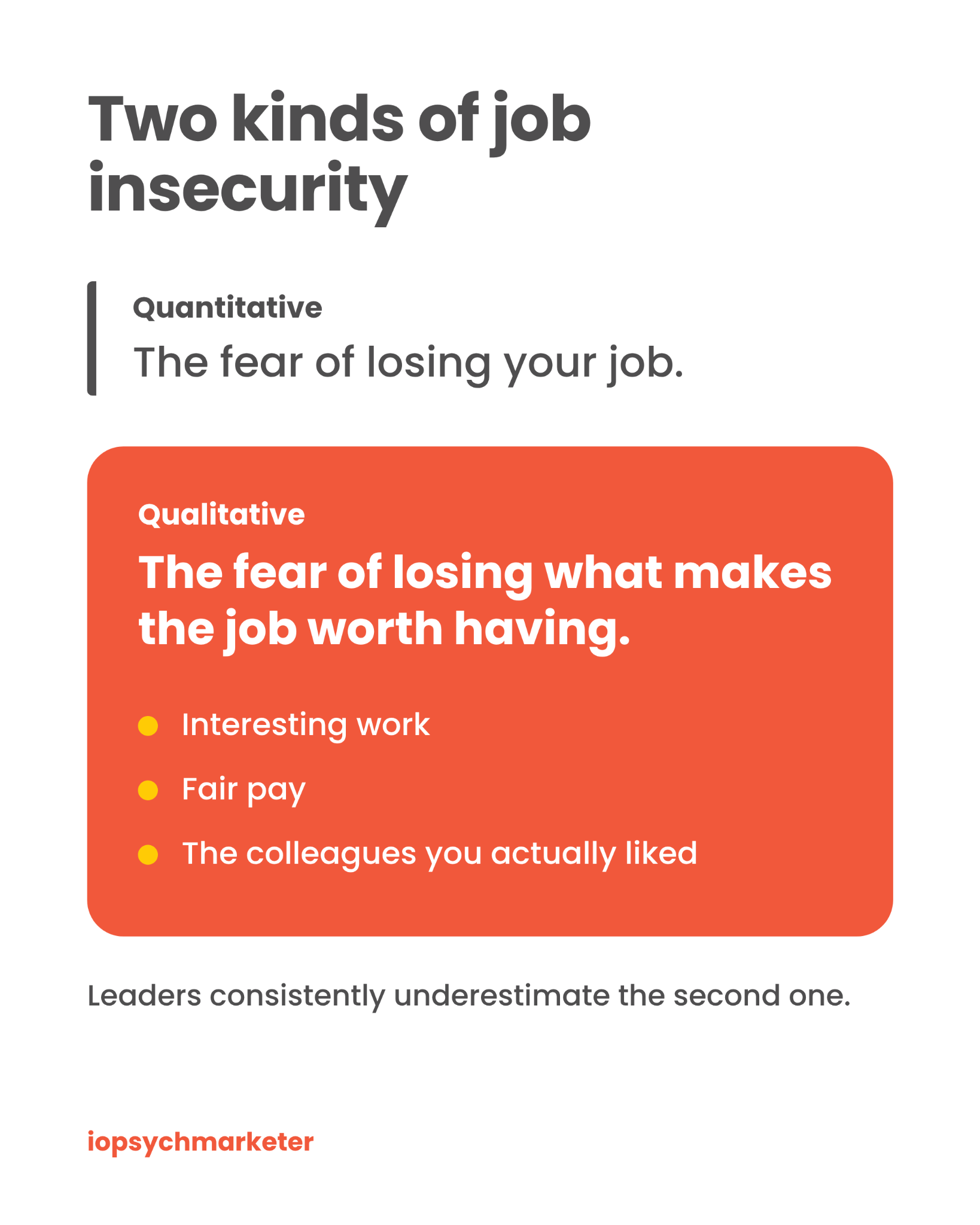
Quantitative job insecurity is the fear of losing your job.
Qualitative job insecurity is the fear of losing what makes the job worth having: interesting work, fair pay, the colleagues you actually liked working with.
You’d think survivors would simply be grateful to still have a paycheck. The research says otherwise. Qualitative job insecurity is linked to depressive symptoms, diminished self-worth, and a loss of interest in life (Van Dam et al., 2020). This is serious stuff.
Why surviving a layoff doesn’t feel like winning
Three well-established lenses explain it.
1. Survivor syndrome
This is the one you’ve probably heard of. Survivors miss their friends and colleagues and sincerely worry about how they’re doing. The research shows survivors experience reduced trust, lower morale, and guilt. Not exactly the setup for a rapid, celebratory transformation. Survivor syndrome is known to hinder goal achievement and undercut people’s ability to cope with what’s in front of them. It’s especially damaging in team-based organizations, where downsizing leaves teams merely surviving rather than thriving (Patton et al., 2024).
It reminds me of a coffee I had with one of my old mentors many years ago. I asked how everyone was doing, and he confided how devastated he was by the layoffs that followed an acquisition. As one of the top revenue-generating partners (and a fantastic leader and mentor), he and his wife were invited to Paris to celebrate the deal. He was so gutted by what happened to his team that he attended the meetings but skipped the “celebratory” boondoggle. Then he quietly bided his time until he could retire, no longer giving it his all as he had done for his entire career.
2. The Job Demands-Resources (JD-R) model
JD-R is a big one in the I/O world. It looks at the balance between what a job asks of you and what it gives you to work with. When demands outstrip resources, you get strain and a decline in both psychological and physical health.
Dlouhy and Casper (2021) found that layoffs reliably produce heavier workloads and unfamiliar tasks at the exact moment support drops away, because supervisors are stretched thinner than ever. Again, doesn’t bode well for quality work or innovation.
3. Threat rigidity theory
This one explains why layoffs so often kill innovation. When perceived threat is high (job insecurity) and perceived control is low (you have no say in the matter), people:
restrict how much information they take in
conserve resources
fall back on familiar standard operating procedures
Leaders, meanwhile, tend to tighten control. Fewer ideas get generated. Risk appetite drops.
So you cut headcount in the name of becoming a faster, more AI-native company, and the predictable result is a workforce that stops experimenting. Fernández-Menéndez and colleagues (2020) found evidence of exactly this pattern: innovation suffers in the aftermath of downsizing.

The result: your best people walk
Stack all three together and you have a workforce that is anxious, risk-averse, overloaded, and under-supported. Then you ask them to drive the transformation. Probably not a great idea.
What comes next is the exodus, and it isn’t your average performers leading it. Your top talent, the people with the most options, are first out the door.
You can see it coming. Cameras off. Colleagues going on medical leave or sabbatical and never coming back. People skipping meetings, or showing up with exhausted faces. Then the goodbye emails start, from more and more experienced people, as the demands on whoever’s left keep climbing until something breaks.
Some survivors get a fast track into leadership, but they’re not ready. Without training, runway, or a backfill for their old job, they can’t deliver what’s expected. Soon they’re out the door too.
What to do before you send the RIF notices
If qualitative job insecurity is the fear of losing what makes work worth doing, the fix is to protect those things on purpose. In motivation research terms, that means protecting people’s sense of autonomy, competence, and relatedness.
Give back some control. Threat rigidity thrives on helplessness, and the research is clear that how leaders lead and manage the change shapes how employees come through layoffs, mergers, and closures (Holten et al., 2019). Let survivors shape how the work gets redesigned, even in small ways.
Rebalance demands and resources, and build competence back up. If the work didn’t shrink, the support can’t either. Newly promoted survivors especially need training and a real plan to backfill their old roles. After one downsizing, survivors learned the work left behind largely by leaning on each other. As one case study title put it, “everybody needs everyone” (Miller et al., 2019). Framing the work around learning and mastery helps too. People oriented toward growth are better able to flourish even under job insecurity (Van Dam et al., 2020).
Honor the loss, and run a fair process. A meta-analysis of downsizing research found that fairness is tied to organizational commitment, for survivors and for those let go (Van Dierendonck & Jacobs, 2012). Survivors are watching how their colleagues are treated. Acknowledging what was lost beats pretending it’s a celebration. Empathy, transparency and two-way communication (where people feel safe to express what’s really on their minds) will go a long way.
So before you send out those RIF notices, have a darn good plan to convince the survivors that sticking around, and staying engaged, is worth their while.
I’m 2 weeks into my “100 conversations” campaign to learn from real people what happens to people when the org changes underneath them. If you’ve lived this, on either side of the RIF, I’d love to hear your story. [Book 30 minutes here.]
References
Dlouhy, K., & Casper, A. (2021). Downsizing and surviving employees’ engagement and strain: The role of job resources and job demands. Human Resource Management, 60(3), 435–454. https://doi.org/10.1002/hrm.22032
Fernández-Menéndez, J., Rodríguez-Ruiz, Ó., López-Sánchez, J.-I., & Delgado-Piña, M. I. (2020). Innovation in the aftermath of downsizing: Evidence from the threat-rigidity perspective. Personnel Review, 49(9), 1859–1877. https://doi.org/10.1108/PR-02-2019-0082
Holten, A.-L., Hancock, G. R., & Bøllingtoft, A. (2019). Studying the importance of change leadership and change management in layoffs, mergers, and closures. Management Decision, 58(3), 393–409. https://doi.org/10.1108/MD-03-2017-0278
Miller, S. M., Kim, J., & Lim, D. H. (2019). “Everybody needs everyone”: A case study of workplace learning after a downsize. European Journal of Training and Development, 44(2/3), 159–170. https://doi.org/10.1108/EJTD-02-2019-0013
Patton, G. K., Neubert, E., Neubert, M. J., & Rees, R. (2024). Surviving, not thriving: The impact of downsizing on team-based organizations. Business Horizons, 67(3), 251–262. https://doi.org/10.1016/j.bushor.2024.02.006
Van Dam, A., Noordzij, G., & Born, M. (2020). Thriving under uncertainty: The effect of achievement goal orientation on job insecurity and flourishing. Social Indicators Research, 150(2), 659–678. https://doi.org/10.1007/s11205-020-02337-4
Van Dierendonck, D., & Jacobs, G. (2012). Survivors and victims, a meta-analytical review of fairness and organizational commitment after downsizing. British Journal of Management, 23(1), 96–109. https://doi.org/10.1111/j.1467-8551.2010.00724.x