


At Tech Week San Francisco last week, I met a lot of people who were genuinely excited about what AI makes possible. The City was alive and buzzing in a way I hadn’t seen in decades. (Yes, San Francisco is back, and it’s invigorating.) VCs and vendors packed every rooftop and warehouse with parties, and young founders were pitching the ideas that will make them the next Mark Zuckerberg.
But unlike the booms of the bast, this one comes with a side of impending gloom. Specifically, P(doom): the odds, as AI insiders put it, that this technology ends badly for humanity. Estimates from AI leaders run from basically zero to near-certain, with many prominent voices landing around 5 to 10%. At the Axios session on data governance I attended, several speakers put it at 0 to 2%, closer to where VC backers like Marc Andreessen sit.
Of course, the people with the lowest estimates can also afford the nicest bunkers. The rest of us will be “negotiating” with the neighbors over the last can of beans. (Maybe the Preppers have been onto something this whole time.)
So it’s no wonder motivation and mental health at work are in rough shape. People are being asked to enthusiastically adopt a technology whose own builders can’t agree on whether it ends the world.
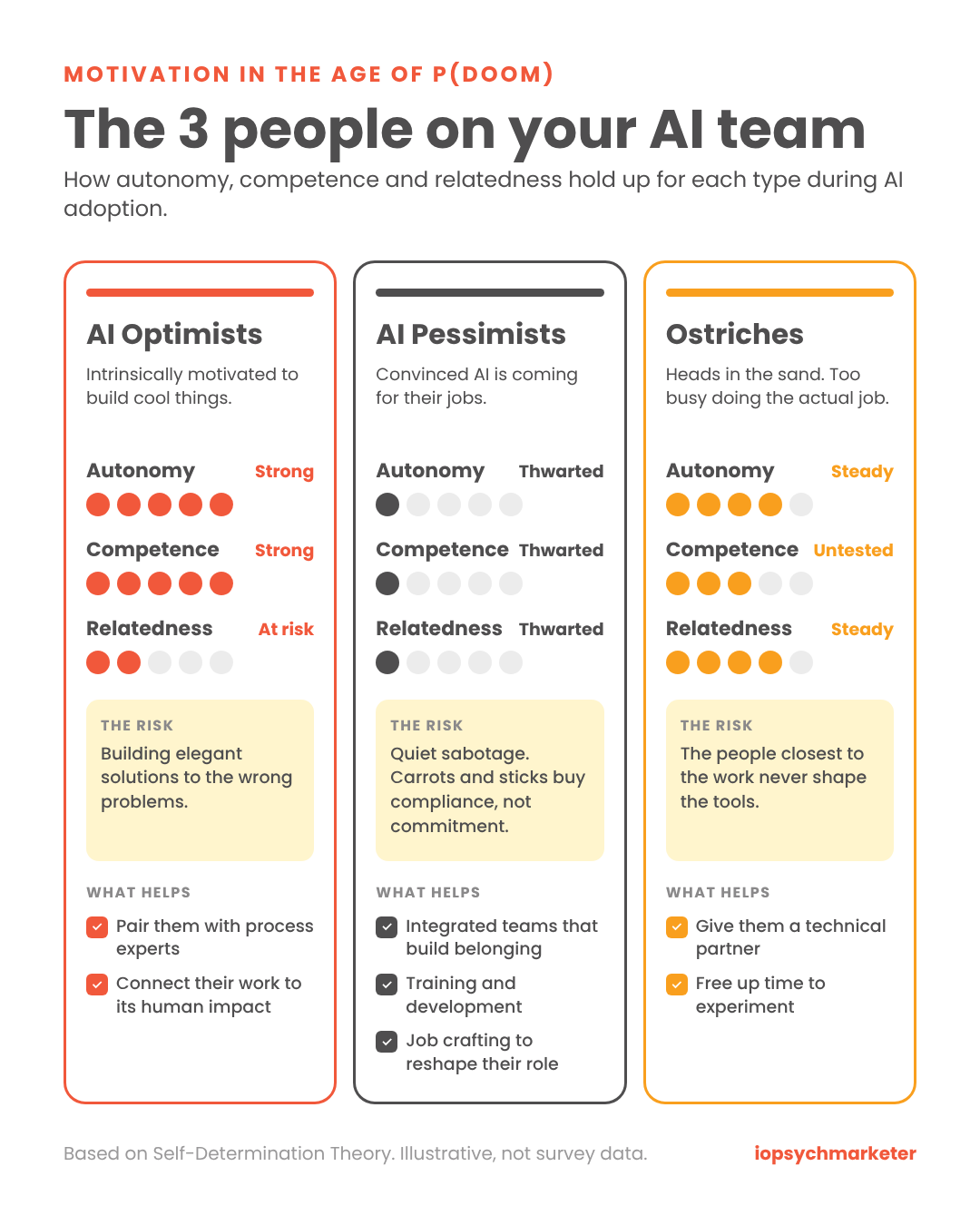
Inside companies racing to adopt AI, I keep seeing three types of people: AI Optimists, AI Pessimists, and Ostriches. Self-Determination Theory (SDT) explains why each one behaves the way they do. People thrive at work when three basic psychological needs are met: autonomy (some control over how I work), competence (I’m good at this and getting better), and relatedness (I belong here). Meet those needs and motivation becomes your most powerful adoption tool. Thwart them and you get something else entirely.
Let me start with a story about thwarting them.
Token quotas destroy autonomy
At Tech Week I spent a long time talking with an AI product manager at a global industrial electronics manufacturer. Her company makes the parts inside a lot of the tech the rest of us build, and her team integrates AI across engineering: code development, testing, DevOps.
She was thrilled about the use cases. The company is growing so fast there simply aren’t enough qualified engineers in the world to keep up. Testing is the perfect target: highly technical, deeply boring, and loved by approximately no one.
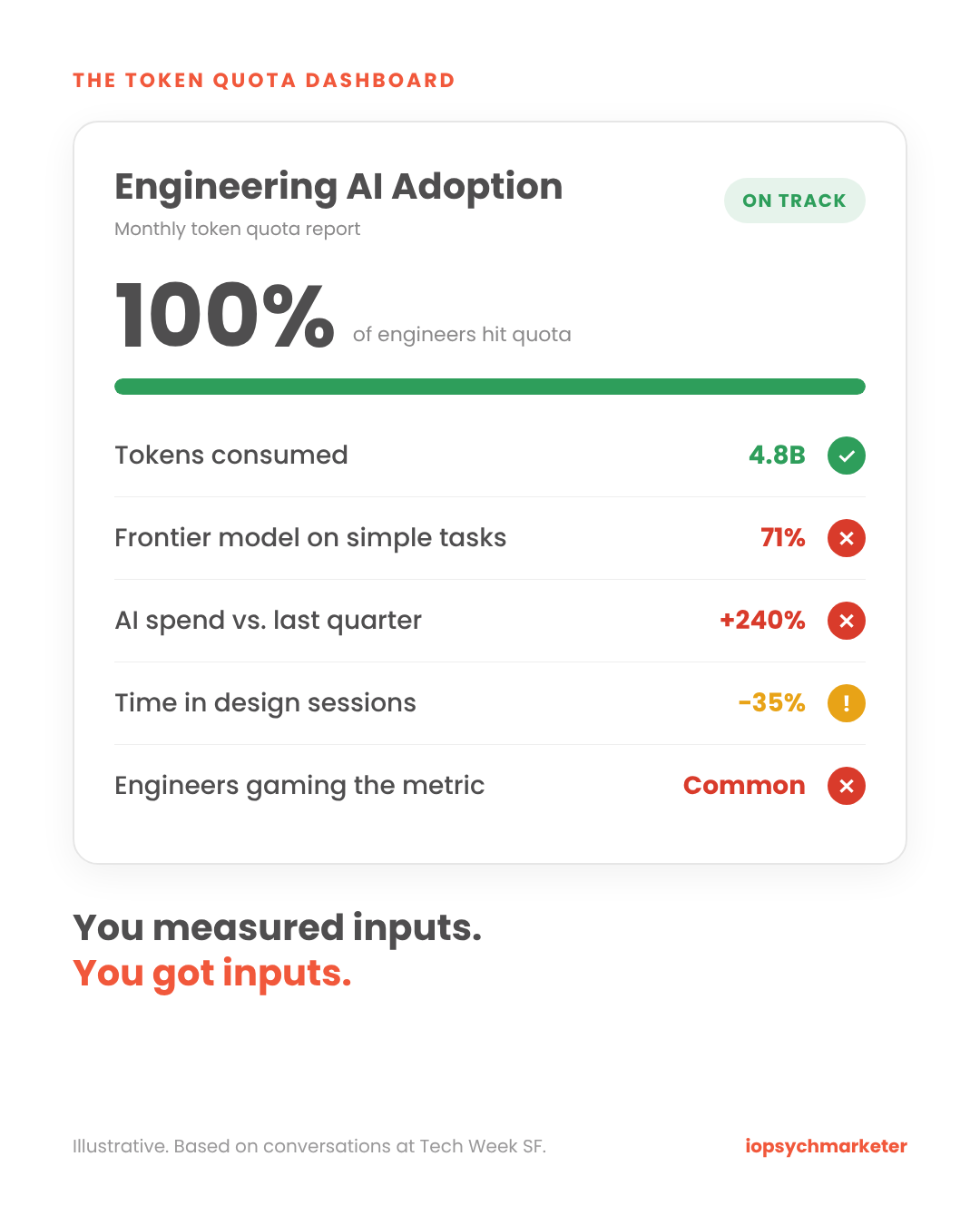
She’s excited about the promise of AI and deeply frustrated by how her organization is rolling it out. You see, her company sets an AI token quota. Every engineer must burn a set number of tokens each month, and anyone who comes in under is assumed to be slacking. Same quota for everyone, regardless of role or team.
She was blunt: that’s not how the work works. Some of her best engineers spend their days in design sessions. Others live deep in the weeds and blow past the quota by mid-month. Not all roles are the same.
I understand how companies get here. Traditional performance reviews are notoriously unreliable (Buckingham and Goodall make the case in Nine Lies About Work), so leaders reach for something they can count. Token consumption is countable.
But here’s what the quota actually does. These engineers are some of the most intrinsically motivated people in the building. They want to use the tools. Slapping an external target on them doesn’t add motivation. It swaps their autonomy for compliance, and that is DEmotivating.
It’s also expensive. Engineers I speak with keep telling me the same thing: under quotas, people start pouring tokens down the drain, running the priciest models on the simplest tasks just to hit the number. You’re paying more for worse motivation.
The fix: measure outcomes, not inputs. Nobody ever got promoted for how much electricity they used
.
The three people on your AI team
Over the past month on my 100 Conversations tour, I’ve talked with many employees and leaders about work, and AI almost always comes up as a core theme they want to discuss. Most people fall into one of three camps: AI Optimists, AI Pessimists, and Ostriches.
AI Optimists
Optimists are intrinsically motivated to build cool things. They figure the doomsayers are mostly trying to hype the technology to sell more tokens. They have the competence to learn the tech fast and love putting it to the test.
Their blind spot is the business. They’re often not experts in the processes they’re automating, so they can build beautiful solutions to the wrong problems.
Their other risk is quieter. I talked with a young AI developer, let’s call her Meera, who knows that if her project succeeds, roughly 1,000 people will lose their jobs. She loves the work. And yet every morning she thinks about the people on the other side of her success metric, which is impacting her mental health.
For Meera, the professional P(doom) for those 1,000 people isn’t a probability. It’s a certainty. Being the job killer is a real burden for AI developers, and for the leaders and HR managers responsible for carrying out mass layoffs.
Individuals associated with layoffs can experience moral injury: psychological distress that comes from doing, or failing to prevent, something that violates your own moral beliefs. The concept is most often studied in the military and healthcare (Litz, 2009). I’d argue it belongs in tech too.
Even your most enthusiastic Optimists can only take so much. Moral injury wears people down, and it shows up in what I/O psychologists call withdrawal behaviors: absenteeism, presenteeism (showing up but checking out), and eventually turnover. Your best builders are the ones you can least afford to lose. Protect their mental health like you’d protect any other critical asset.
AI Pessimists
Pessimists believe AI is coming for their jobs, and some of them are actively working against your rollout. This isn’t hypothetical. In a 2026 survey by Writer and Workplace Intelligence, 29% of employees admitted to sabotaging their company’s AI strategy, from refusing to use the tools to feeding company data into unapproved ones (Fortune).
Here’s the part leaders should sit with. Among the saboteurs, 30% cited fear of losing their job. But 26% blamed a poorly executed AI strategy. Token quotas, anyone?
Through an motivational theory lens, Pessimists have all three needs under threat. Competence: they feel behind. Autonomy: the tools are being dictated to them. Relatedness: it’s starting to feel like human versus machine (and they resent the Meera’s of the world building them).
Leadership’s instinct is carrots and sticks. In the same survey, 60% of executives said they’re considering cutting employees who refuse to adopt AI. SDT predicts how that goes. Rewards and threats can buy compliance, but not commitment. You’ll get people logging in, not people leaning in.
Ostriches
Ostriches haven’t thought much about AI at all. Their heads are in the sand, either because tech doesn’t interest them or because they’re too busy doing their actual jobs to study it.
They’re not anti-AI. They’re usually deep in the very processes that most need automating, and they’re secure enough in their roles that AI doesn’t scare them. Give them a technical partner who frees up some time, and they’ll welcome the help. They just don’t want to build the models themselves.
So what do you do?
1. Integrate your teams
Stop leaving these groups in separate corners. Put them on integrated teams solving real problems together.
Optimists and Ostriches are a natural pair. The Optimists bring the tech. The Ostriches bring the process knowledge that keeps Optimists from solving the wrong problem. And the time the Optimists free up gives Ostriches room to finally pull their heads out of the sand and try the tools themselves.
Integrated teams help Pessimists too. Working closely alongside people builds relatedness, and over time, psychological safety: the belief that you can ask a dumb question or admit you’re lost without paying for it. That safety is the foundation motivation grows from. Nobody experiments with a tool they’re afraid to be seen fumbling.
2. Grow the top line, not just cut costs
To avoid organizational P(doom), point your AI initiatives at growth, not only at cost cutting.
IKEA is the go-to example. In 2021 IKEA launched Billie, an AI customer service bot that now handles 74% of the customers who use it. Instead of laying off the call center workers whose jobs Billie absorbed, IKEA spent two years retraining roughly 8,500 of them to resolve complex issues or work as interior design sales advisors.
The payoff: IKEA’s remote-sales centers are now the company’s fastest-growing sales channel, bringing in €1.25 billion last fiscal year, up from €1.08 billion. Its customer happiness score rose to 89%, from 60% before Billie (Fortune).
While the design consultations are free; the money comes from what customers buy afterward. And IKEA isn’t a no-layoffs utopia. Its two parent companies, Ingka and Inter IKEA, each cut hundreds of corporate roles this spring. None of those cuts touched the remote-sales centers, and none were attributed to AI. Ingka’s chief digital officer also didn’t rule out future cuts.
That’s actually the lesson. IKEA’s reskilled workers are protected because they’re attached to a revenue line, not because the company is sentimental. Reskilling that shows up as goodwill gets cut in the next downturn. Reskilling that shows up as booked sales has someone fighting for its budget.
AI will reshape your organization either way. Whether it lands as a growth story or a P(doom) story depends far less on the technology than on whether your people feel autonomous, competent, and connected while it happens.
Sources
Inside Ikea’s big bet on humans in the age of AI, Fortune, July 30, 2026 (all IKEA figures and the spring layoffs)
Gen Z workers are so fearful AI will take their job they’re intentionally sabotaging their company’s AI rollout, Fortune, April 8, 2026 (Writer and Workplace Intelligence survey)
Marcus Buckingham and Ashley Goodall, Nine Lies About Work (2019)
Litz, B. T., Stein, N., Delaney, E., Lebowitz, L., Nash, W. P., Silva, C., and Maguen, S. (2009). Moral injury and moral repair in war veterans: A preliminary model and intervention strategy. Clinical Psychology Review, 29(8), 695–706.