


I’ve been a project management evangelist for most of my career. From my early days as a management consultant, I learned fast: if it isn’t on the plan, it doesn’t exist. I’ve built Kanban boards, run scrum ceremonies, and tracked work in all the PM apps including MS Project, Jira, Asana, Workfront, and Smartsheet — sometimes in the same quarter. I believe deeply in structured work management.
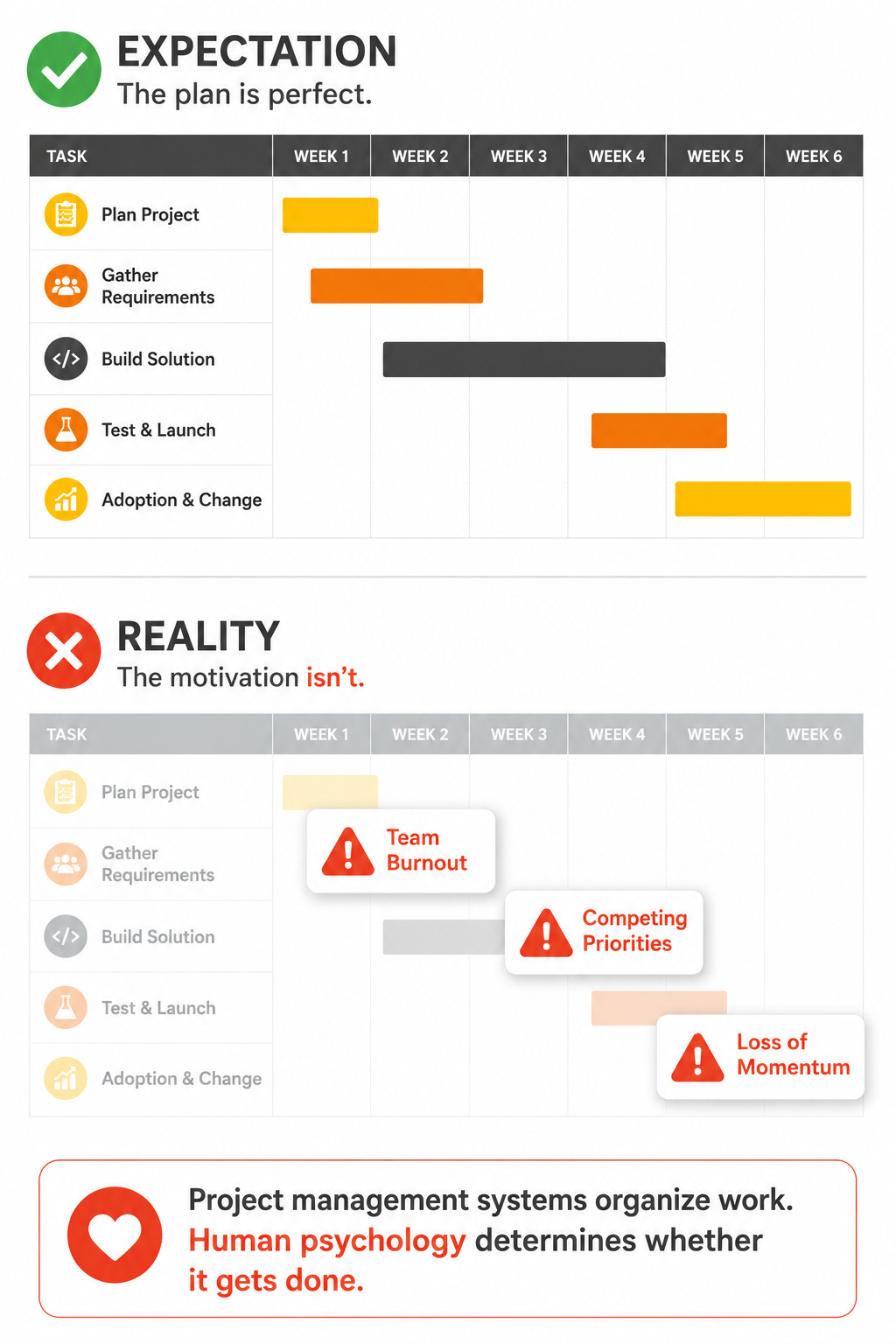
And yet. I’ve watched meticulously organized projects die quiet deaths, not because the plan was wrong, but because the people executing it ran out of steam. The Gantt chart was perfect. The motivation was not.
Here’s what I’ve come to understand: project management systems are containers. What fills them — or doesn’t — is human psychology. Organizational psychology has a lot to say about why some people and teams drive through their goals while others stall out before the first milestone. Two theories in particular have changed how I think about getting work done, and a third reframes what leadership even looks like in the context of a project.
When too many goals are the problem: Dual-Goal Expectancy Theory
Schmidt and Dolis’s (2009) dual-goal expectancy theory offers a pretty obvious point: there’s a limit to how many hard things a person can pursue simultaneously before performance on all of them degrades. When the combined demands of multiple difficult goals exceed available cognitive and motivational resources, something has to give — and it usually gives messily, without us quite realizing it’s happening.
When your team is buried, the answer isn’t a longer to-do list. Get the goals out of their heads and onto a surface where real trade-offs can be made — then protect them from everything that didn’t make the cut.
I see this play out constantly in organizational settings. A marketing team running too many campaigns simultaneously. A tech team rolling out too many new systems all at once. A customer success team managing too many client deployments. A sales team chasing too many “hot” leads. In these cases, you end up operating in a resource deficit that no amount of prioritization theater will fix. The dual-goal model tells us that in these situations, leaders need to make genuine trade-offs, not just add another color to the roadmap.
I see it at home too, particularly with my high schooler who has a particular brand of paralysis that sets in around homework: the more she has, the less she can start any of it. When it gets really bad, I have her write each assignment on a Post-It, and we arrange the cards on a 2x2 matrix — high vs. low impact on one axis, high vs. low difficulty on the other. Then we sequence: easy wins with big impact first, harder high-impact work next, with deliberate breaks woven in. Sure enough, what felt like an insurmountable burden at 4pm is a distant memory by bedtime.
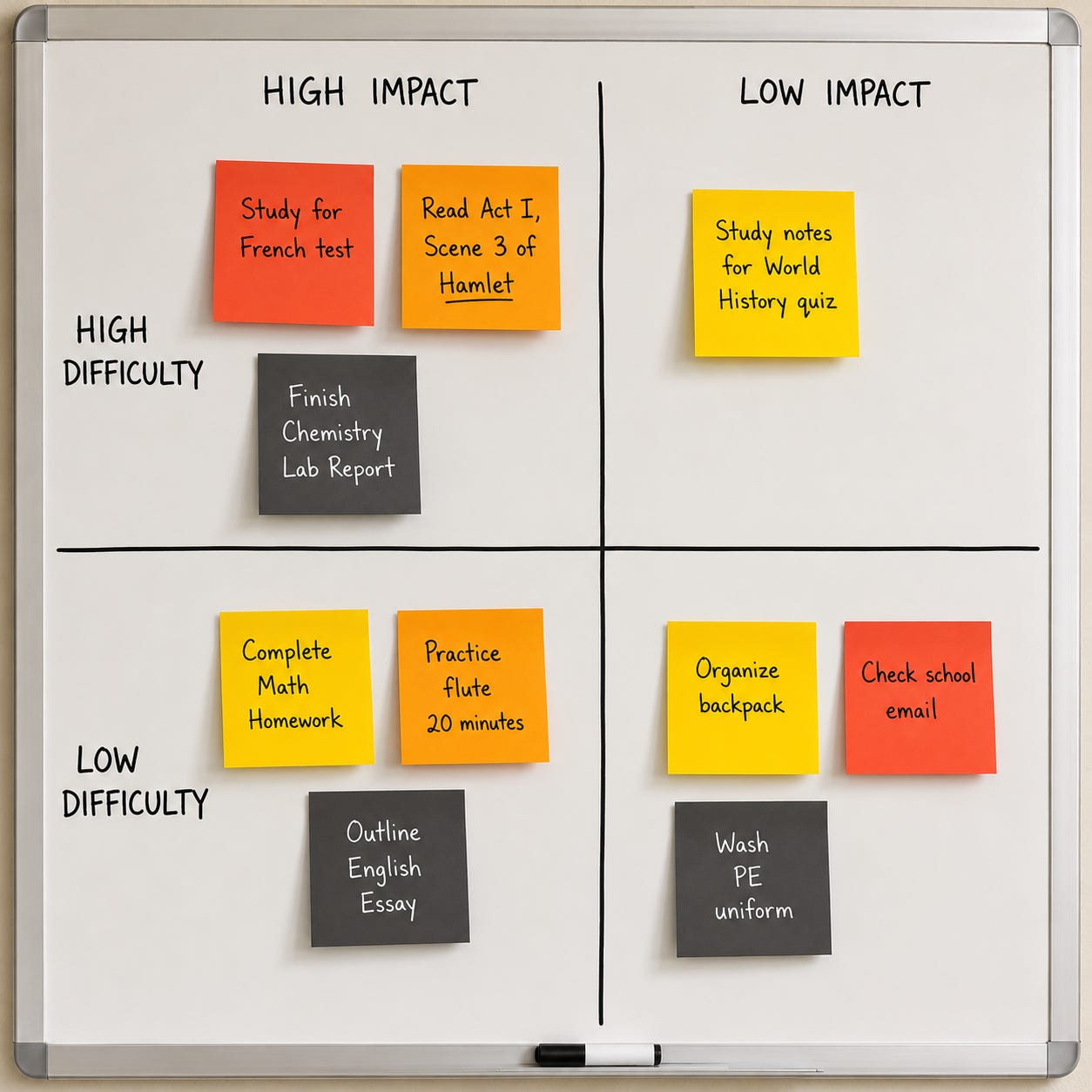
The 2x2 isn’t magic. What it does is externalize the cognitive load of prioritization, so she’s not spending her limited resources just figuring out where to start. As I mentioned in my piece on precrastination, the brain likes done. For managers, the lesson is the same: when your team is buried, help them get the goals out of their heads and onto a surface where trade-offs can actually be made. Then protect them from everything that’s not on the short list.
When autonomy and competency is the point: Self-Determination Theory
Deci and Ryan’s Self-Determination Theory (SDT) identifies three core psychological needs that, when met, produce the kind of intrinsic motivation that sustains long-haul work: autonomy (the sense that one’s actions are self-directed), competence (the sense that one is capable and growing), and relatedness (genuine connection to the people around you).
Intrinsic motivation isn't a personality trait — it's a condition. When people feel autonomous in their work, competent in their role, and genuinely connected to their team, sustained performance follows.
In the workplace, SDT explains a frustrating phenomenon leaders encounter often: you can have a well-designed project with clear milestones and adequate resources, and it still goes sideways because people feel micromanaged, undertrained, or isolated from the work’s larger purpose. External motivators — performance bonuses, social recognition, the implicit threat of a bad review — can drive short-term compliance. What they can’t do is sustain the kind of engaged, discretionary effort that complex, creative work requires.
Deci et al. (2017) found that when people are more autonomously motivated and feel connected to the purpose of their work, they are able to “perform better, learn better, and be better adjusted.” For managers, this translates into some concrete practices: give people room to decide how they achieve a goal, not just what the goal is. Invest in building competence through real skill development, not just performance feedback. And don’t underestimate the relatedness piece — the degree to which people feel connected to their teammates is a stronger predictor of sustained effort than most compensation models would suggest.
From a project management standpoint, sometimes teams get stuck when they aren’t given the autonomy or feel competent enough to make the decision to get the job done. As a manager it’s your job to help them get there.
While we all want things to be 100% to our liking, sometimes 90% there is good enough. Because 90% done is still 100% incomplete.
When leadership style is the variable: Path-Goal Theory
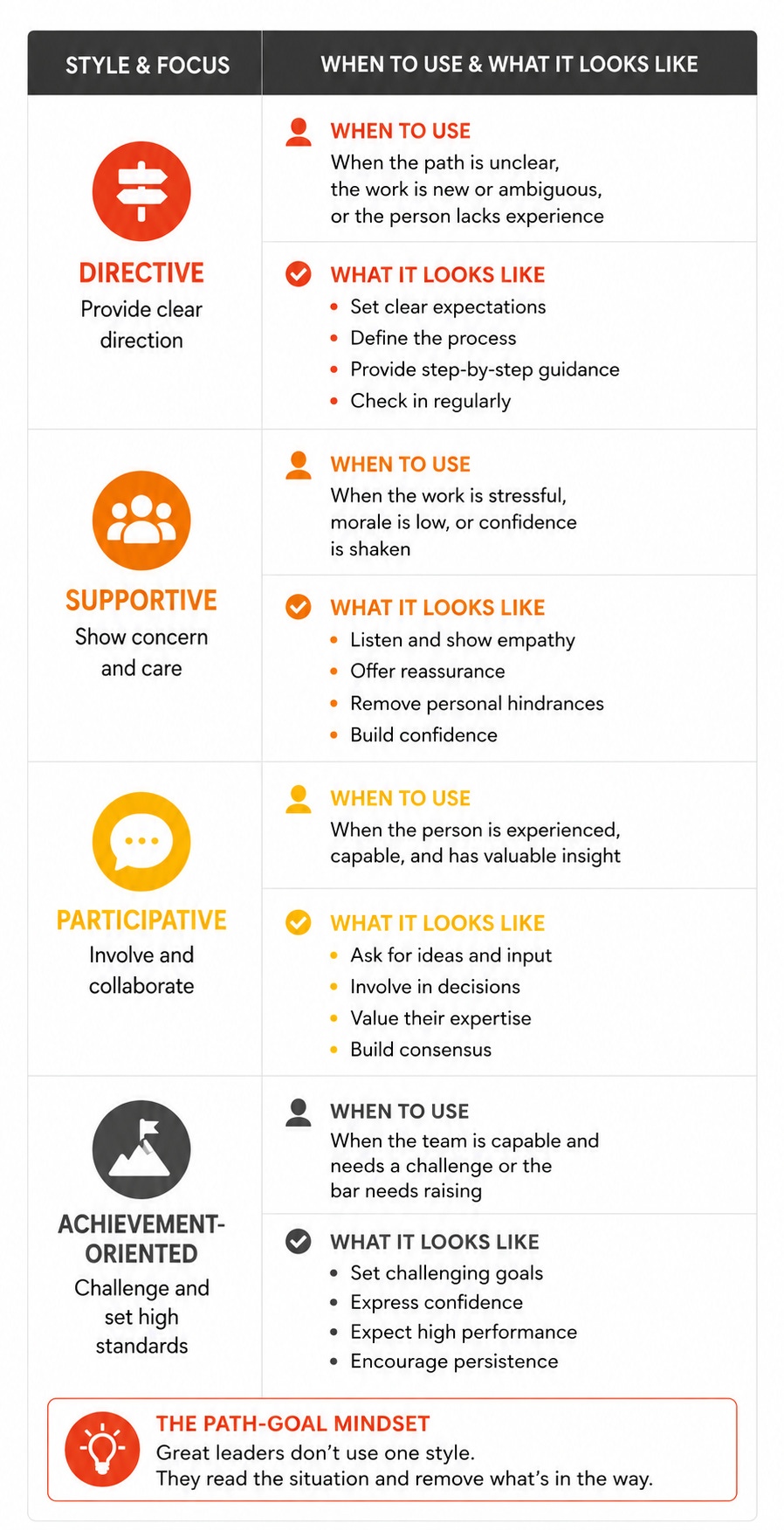
Robert House’s path-goal theory starts with a deceptively simple premise: a leader’s job is to clear the path between an employee and their goal. Not to own the goal. Not to dictate the route. To remove what’s in the way and provide what’s missing — and to recognize that what’s missing looks different depending on the person and the situation.
House identifies four leadership behaviors, and the key insight is that effective leaders move fluidly between them rather than defaulting to a single style. Directive leadership — clear expectations, defined process, regular check-ins — is exactly what a new team member needs when navigating an ambiguous project. Apply the same approach to a seasoned high-performer and you’ve just micromanaged someone who knew what they were doing. That person needs participative leadership: draw on their expertise, involve them in decisions, treat them as a co-author of the plan rather than an executor of yours.
Effective leaders don’t pick a style and stick with it. They read the situation — and match their approach accordingly: directive when the path is unclear, supportive when morale is low, participative when expertise is in the room, achievement-oriented when the bar needs raising.
Achievement-oriented leadership — setting high standards, expressing confidence in the team’s ability to meet them, resisting the urge to lower the bar when things get hard — is what stretch goals require. Supportive leadership, by contrast, is what people need when the work is stressful, the stakes are high, or morale has taken a hit. None of these is universally right. All of them are situationally necessary.
In practice, this means paying attention. Not just to the project board, but to the person sitting across from you in the one-on-one. Is he underwater and needs someone to remove three things from his plate? Is she bored and needs a harder problem? Is the team demoralized after a missed deadline and needs acknowledgment before they can regroup? Path-goal theory won’t answer those questions for you — but it gives you the right questions to ask, and a repertoire of responses when you have the answer.
The leader who picks a style and sticks with it regardless of context isn’t being consistent. They’re being inattentive. And on a long project, inattentiveness to what people need is one of the most reliable ways to watch a plan quietly fall apart.
What this has to do with your project plan
The project management industry has given us increasingly sophisticated tools for tracking work. What it’s less good at is explaining why people do — or don’t — do it. The gap between a well-built plan and a completed one is almost always motivational, not methodological.
Dual-goal expectancy theory reminds us that cognitive and motivational resources are finite, and that genuine prioritization — not just a ranked list, but real trade-offs — is a leadership act. Self Determination Theory tells us that autonomy, competence, and relatedness aren’t soft perks; they’re the substrate on which sustained performance is built. And path-goal theory gives us a framework for reading what a person or team actually needs in the moment, and the flexibility to meet them there.
The best plan you’ll ever build is still just a document. What moves work forward is people who are motivated to do it — and leaders who understand what that actually takes.
References
Deci, E. L., Olafsen, A. H., & Ryan, R. M. (2017). Self-determination theory in work organizations: The state of a science. Annual Review of Organizational Psychology and Organizational Behavior, 4, 19–43.
House, R. J. (1971). A path-goal theory of leader effectiveness. Administrative Science Quarterly, 16(3), 321–339.
Schmidt, A. M., & Dolis, C. M. (2009). Something’s got to give: The effects of dual-goal difficulty, goal progress, and expectancies on resource allocation. Journal of Applied Psychology, 94(3), 678–691.