


In “Take a Break,” one of my favorite songs from the musical Hamilton, Eliza and Angelica beg Alexander to leave his desk — just for the summer — and come with them to their father’s lakehouse up state. He refuses. He insists he has so much on his plate. He’ll lose everything if he doesn’t get his plan through Congress. We know what follows: the empty house, Maria Reynolds at the door, the affair and the blackmail, which he resolved by public confession that led to Eliza’s devastating silence and, eventually, his son’s death in a duel defending his father’s honor. The legacy Hamilton sacrificed his family to build outlasted him only because Eliza spent the rest of her life preserving it.
Most of us aren’t Alexander Hamilton. But many of us are running his playbook.
We take our one or two weeks, stress out packing and prepping, coordinating the petsitter, sitting in traffic, waiting for airplanes and then compulsively checking Slack from the pool, and come home more depleted than when we left. We call it a vacation. Our nervous systems know better.

As a busy mom of 3, student, and writer with a full-time job leading a large team, I understand the gravitational pull of the grindstone.
I also know, intellectually, that rest is one of the highest-leverage things I can do — not just for my family but for my own health, creativity, and productivity. The research is unambiguous on this. So why is it so hard to do?
I’ve been thinking a lot lately about what real rest actually looks like. And I think most of us — and most organizations — are getting it badly wrong.
The truth about “unlimited” vacation (it’s rather limited)
Anyone who’s been offered unlimited vacation will tell you it sounds better than it is. The policy looks great in a recruiting deck. The reality is something else.
Without a set number of days, there are no guardrails — no HR nudges to “use it or lose it,” no social norm telling you how much time off is actually acceptable. So people default to peer pressure and perceived performance expectations, which almost always point toward working more, not less.
In fact, a study by HR platform Namely found that employees with “unlimited” vacation actually take fewer days off on average (13) than those with a traditional policy (15). The freedom to take any amount of time off quietly becomes permission to take less.
From a purely financial standpoint, unlimited vacation looks like a good deal for companies: they don’t have to pay out accrued time when employees leave. But the increased turnover that results from breach of trust it creates, and the burnout it fails to prevent, erodes whatever savings it generates. Research by de Bloom et al. (2022) found that while unlimited paid time off can increase feelings of accountability and control it just as easily can spark guilt, uncertainty, and self-endangering work behaviors, including chronically long hours and exhaustion. The policy, in other words, can make the very problem it’s supposed to solve significantly worse.
Conversely, there’s compelling data suggesting significant ROI from offering long-term time off that makes a real dent in burnout and associated turnover intentions. And yet few organizations in the U.S. offer anywhere near enough time off for genuine rejuvenation.
What rest actually looks like
The word sabbatical comes from sabbath — the day of rest. I didn’t really understand what that phrase meant until I got to know David, a friend and university professor who practices Orthodox Judaism. Not knowing much about the practice, I asked a lot of questions. I soon found myself in awe of the discipline and intentionality of it — the care he takes to stay kosher, to honor the sabbath, to observe each week’s rhythms. When I got the invite to attend his infamous weekly Shabbat dinner, I accepted immediately. The food was extraordinary. The conversation was warm and unhurried. And when the meal ended, no one reached for a phone. No one pivoted to logistics. People just stayed at the table. Talking. Being together.
What struck me most was how consistent he is. David adheres to his practice regardless of how inconvenient it might be. When it came time to attend my wedding on a rainy Saturday afternoon, he walked 3 miles to our church and another 2 to the reception, because that’s what keeping the sabbath requires. No machinery. No money changing hands. No headphones. No podcasts. No popping into the nearest café along the way to grab a coffee. Just the walk — in silence, or in conversation with a friend. For one day each week, he rests. Fully and without negotiation. And with grace, contemplation, and peace that no doubt fuels his creativity and productivity. What seems like a lot of work to an outsider actually brings true peace. It takes discipline to rest fully, and few of us have the will or opportunity to follow this example — but we could all benefit from the structure.
David doesn’t just fully rest once a week. As a tenured professor, he takes longer rests on a regular cycle too — a full semester-long sabbatical every few years. It’s structured. It’s protected. And it’s long enough to actually matter.
The case for real sabbaticals
What do universities know about rest that the rest of us could learn from? They don’t offer sabbaticals out of the kindness of their hearts — they do so because it leads to better results.
Universities have long understood that genuine, extended time away improves productivity, sparks creativity and innovation, deepens expertise, and reduces the kind of burnout that drives talented people out the door.
While some companies advertise “sabbaticals” as a benefit, most of what they’re offering isn’t a sabbatical in any meaningful sense. An extra week or two of vacation every five years or so isn’t a sabbatical — it’s a long weekend with better branding. It almost certainly won’t move the needle on burnout or retention, which means the cost isn’t justified by the return. Even four weeks away isn’t enough for genuine psychological recovery.
Companies would be better served by offering real sabbaticals — a minimum of eight weeks, on a predictable schedule, structured so employees can actually disconnect.
The financial case is stronger than most people expect — and the math rewards generosity. A study of burned-out nurses by Schaar & Swenty (2012) explored the cost-benefit of sabbaticals and found that a 12-week sabbatical for five at-risk nurses cost $187,150 — far less than the $320,000 it would cost to replace them all, and still cheaper than replacing just three. In other words, the program paid for itself even when 40% of participants didn't return.
Using Schaar & Swenty’s example, I modeled the value created at different sabbatical lengths for knowledge workers, with modeled retention rates based on recovery research: the longer the leave, the more genuine the restoration, and the more likely people are to return.
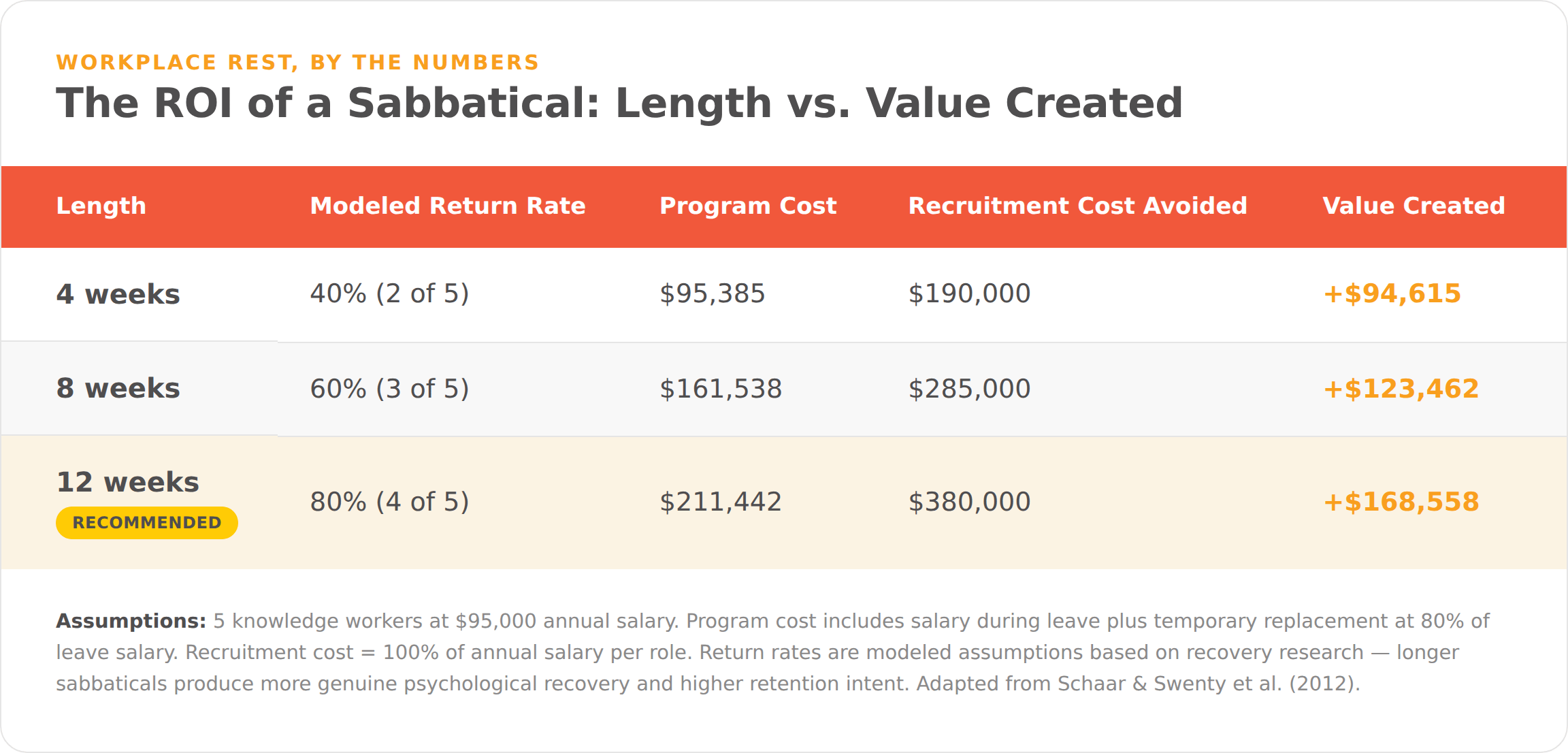
While the retention improvements in this model are hypothetical, there's substantial evidence that longer breaks meaningfully increase retention. The financial implications are pretty clear. A 12-week sabbatical creates nearly $170,000 in value per cohort of five employees — almost double what a 4-week program generates. That's because recovery isn't linear. A four-week leave barely scratches the surface of genuine psychological restoration. A twelve-week sabbatical gives people enough time to decompress, remember why they loved their work in the first place, and choose to come back. The counterintuitive conclusion: the companies offering the stingiest sabbaticals are likely leaving the most money on the table.
Finding your own sabbath
I haven’t cracked the code on true rest personally — but I’m trying. Over the years I’ve tried digital-free Sundays, blocking downtime on my calendar, enforced separation from what my family refers to as the “holy rectangle.” I’m intrigued by these Brick devices many college students I know use to protect themselves from the compulsion to check their phones. We’re all, it seems, looking for a little structure to hold us accountable to rest.
For me, building a buffer around family vacations has been essential. Instead of short vacations moving from work to adventure and back to work again, I take longer breaks building in a couple of days on each end of my vacations at home to decompress and get organized.
This week, I’m closing the work laptop. Not for a long weekend. Not for a week. Two full weeks. I’ll spend my time reading and relaxing in my new hammock and then head up to my sister’s house in the Sierras for quality family time where phones don’t work.
Alexander Hamilton never went to the lakehouse. He stayed at his desk, building his legacy, until his legacy — and his marriage, and eventually his life — fell apart.
I’m going to the lake.

PS - in the spirit of the theme of rest, this Substack will be on pause for the next 2 weeks. See you mid-July with some (hopefully) inspired posts.
Share in the comments what plans you have to disconnect and how you plan to re-energize yourself this summer.
References
de Bloom, J., Syrek, C. J., Kuehnel, J., & Vahle-Hinz, T. (2022). Unlimited Paid Time Off Policies: Unlocking the Best and Unleashing the Beast. Frontiers in Psychology, 13, Article 812187. https://doi.org/10.3389/fpsyg.2022.812187
Schaar, G. L., Swenty, C. F., Phillips, L. A., Embree, J. L., McCool, I. A., & Shirey, M. R. (2012). Nursing Sabbatical in the Acute Care Hospital Setting: A Cost-Benefit Analysis. JONA: The Journal of Nursing Administration, 42(6), 340–344. https://doi.org/10.1097/NNA.0b013e318257390f
White, J. B. (2024). Sabbatical Leave in the Private Sector: An Employee Benefit That Can Be a Cost Saver. Compensation and Benefits Review, 56(4), 249–260. https://doi.org/10.1177/08863687241259860
If you enjoyed this and know anyone who’s curious about industrial-organizational psychology and wants to understand these concepts in layman’s terms, please share.
Enjoy the lake!!! Another interesting read. Thank you!
It was a wonderful week at the lake.
What does it take to get employers to take the long view with their employees? Whether its a sabbatical or paid medical or family leave?