


If you’ve been following along for the past few weeks, you’ve read about the common paths to power that put unskilled people in roles they’re not prepared for. You’ve learned about the cognitive bias known as Dunning-Kruger that shows up when unskilled, unaware people land in positions of power anyway. And you’ve met real and on-screen examples of leaders who reached the top, some who used that power well, and some who very much did not.
So by now you might be thinking: we’re doomed. If unskilled people keep ending up at the top, what can we possibly do about it?
Good news: there are evidence-backed ways to catch this before it costs you. Here are a few I uncovered in my research.
Recruiting & Selection
The cheapest fix happens before you even hire someone.
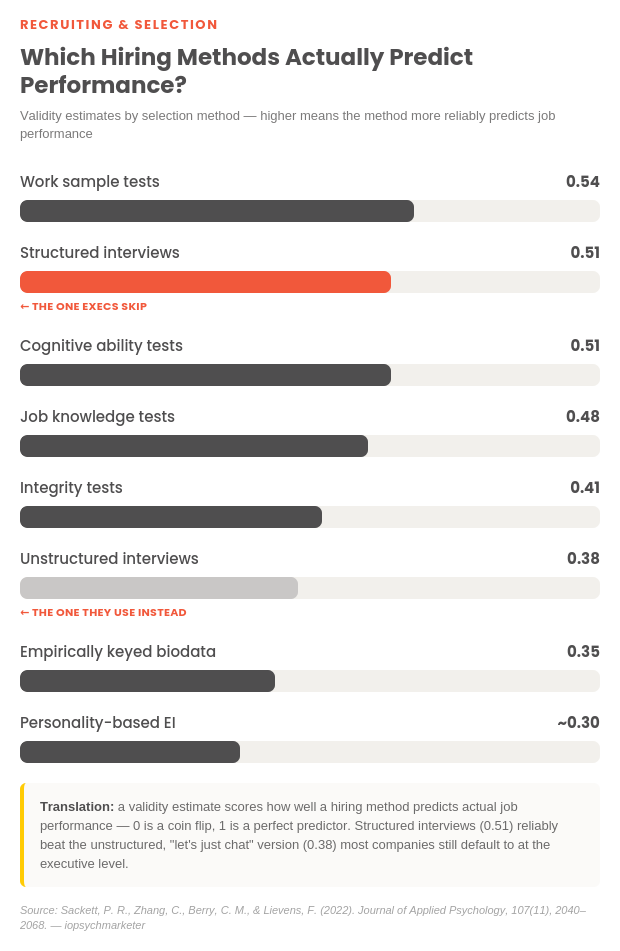
Instead of trying to manage an unskilled leader after the fact, a good recruiting and selection process lets you screen for skill and behavior instead of vibes. Any I/O psychologist will tell you the single most effective selection tool available is the structured interview in terms of validity and ease of execution. Structured interviews involve pre-set battery of questions that are targeting specific job skills and have a .51 validity estimate* as compared to just .38 for the unstructured, “tell me about yourself” version companies love to use instead (Sackett et al., 2022). Structured interviews are common enough at the entry level. But how many companies are actually running them for their executive hires? Rarely. And even less so for internal candidates who already have the inside track for a promotion.
*TRANSLATION: a “validity estimate” is just a score for how well a hiring method actually predicts whether someone will be good at the job. It runs from 0 (no better than a coin flip) to 1 (a perfect predictor). A .51 for structured interviews means the results reliably lined up with how well people actually performed once hired. A .38 for unstructured interviews means: still somewhat useful, but a lot less reliable — closer to going with your gut.
Here’s the data, if you want receipts:
So if we’re running structured interviews for our leaders, what should we actually be looking for? Alzahawi et al. (2024) suggest recruiting should focus on people with an intrinsic motivation to lead rather than letting the most ambitious candidates dominate the pool. Look for people who are prosocial, collectively minded, and genuinely committed to the group’s success over their own (Alzahawi et al., 2024).
My lunch at Gott’s
When I was a young management consultant, I sat in on plenty of candidate interviews myself. We went through a lot of training on what we could ask, and what we couldn’t. Each of us was handed a set of questions to draw from, with specific ones assigned to each interviewer. As an interviewer, that structure was a gift. I always knew exactly what to look for, and there was never an awkward moment where I had to improvise a question on the spot.
Some organizations take this much further. AWS is infamous in the tech industry for how rigorous its recruiting process is. Having gone through the process a decade ago, I still have a bit of PTSD about how hard they drilled, right down to being advised to bring a single sheet of paper with the specific stats I’d cite about my own success.
The highlight of my interview day was the lunch with my assigned “buddy” who had joined the company just a month earlier. I vividly recall our lunch at Gott’s at San Francisco’s Ferry Building (yum!), where I tossed out my standard candidate question: “Tell me the good, bad and ugly about this job.”
Little did I expect her to be so transparent, nearly breaking down in tears telling me about the times she’d been yelled at and demeaned in meetings for not being prepared enough despite being brand new on the job. That confirmed that it wasn’t the right culture for me (and honestly, it probably wasn’t a good fit for her either), but the process also draws in people thrive in cultures with that type of rigor and intensity. The point is: the process worked, and both sides walked away with no regrets.
That’s the whole idea behind structured selection: it doesn’t let you coast on vibes, however good yours might be. But if it only predicts 51% of liklihood of success, it’s often not enough. That’s why you need to look at candidates from mutiple perspectives. From there, run a real battery of tests screening for the knowledge, skills, abilities, and personality traits that predict good decision-making instead of looks and charisma. There are dozens of validated assessment tools that can be leveraged to look for specfic personality traits or characteristics you can use to screen for the leadership skills you need.
Training & Coaching
Selection isn’t the only lever. Leaders can also be trained out of their metacognition deficiencies. Or at least to a point.
A 2023 study by Joie-La Marle et al. found that metacognition-focused soft skills training improved self-efficacy and adaptive performance across creative problem-solving, reactivity, interpersonal adaptability, and stress management.
While I wasn’t able to find any examples on training folks out of DKE, I did find an interesting paper by Geringer et al. (2025) who studied ten high-performing physicians exhibiting through imposter syndrome (or phenomenon). This is when people underestimate their abilities instead of overestimating them. The researchers found that through reflection, feedback, and emotional awareness physicians exhibiting imposter syndrome were able to recalibrate their self-assessments. Since imposter syndrome and DKE sit on opposite ends of the same calibration spectrum (Bodislav & Georgescu, 2025), it’s a reasonable bet that training which helps one direction could help the other — though nobody’s tested that directly yet.
While I didn’t go down the coaching rabbit hole (50 academic papers were enough), my TA pointed me toward a body of research showing executive coaching can be effective here too, especially when the organization is actually sponsoring the coach and treating the metacognition gap as a real priority rather than a box to check.
The Real Problem: Nobody Wants to Have This Conversation
Here’s the part nobody wants to say out loud: telling a powerful, possibly narcissistic executive that they might be the problem is a career-limiting move. On paper, these interventions are simple. In practice, almost no one at a company has the standing — or the nerve — to raise it.
That’s why this can’t be left to individual courage. It has to be systemic. At the executive level, that responsibility sits with the Board and Risk/Regulatory functions, who can build selection and training requirements into policy rather than hoping some brave soul speaks up in the room.
Where This Leaves Us
If you’ve read this far, congratulations — you’re deep in the weeds of DKE.
Across this series, we’ve seen that the paths that get someone into a leadership role — ambition, appearance, conversational dominance — have almost nothing to do with whether they’ll actually be good at the job. When leaders exhibiting Dunning-Kruger ignore or dismiss expertise, they erode trust and make overconfident decisions that hurt organizational performance (Nold & Michel, 2023).
The fix isn’t complicated, even if it’s uncomfortable: screen for metacognitive awareness and prosocial traits on the way in, and invest in real training and coaching once people are already in the seat. Direct research on training DKE specifically is still thin, but the imposter syndrome research gives us a solid reason to believe recalibration is possible in both directions.
My take: the organizations that get serious about this and stop treating charisma, appearance, and ambition as proxies for leadership ability are the ones that will avoid becoming the next Enron, Theranos, or WeWork story. The research is there. What’s missing is the will to act on it.
References
Alzahawi, S., Reit, E. S., & Flynn, F. J. (2024). A legend in one’s own mind: The link between ambition and leadership evaluations. PNAS Nexus, 3(8). https://academic.oup.com/pnasnexus/article/3/8/pgae295/7736721
Bodislav, D. A., & Georgescu, R. I. (2025). New organization heights—The impostor’s impostor syndrome. Encyclopedia, 5(1), 21. https://doi.org/10.3390/encyclopedia5010021
Geringer, J., LaDonna, K., Varpio, L., & Merkebu, J. (2025). Recalibrating self-assessment: Navigating imposter syndrome through metacognitive reflection. The Clinical Teacher, 22(5), e70197. https://doi.org/10.1111/tct.70197
Joie-La Marle, C., Parmentier, F., Weiss, P.-L., Storme, M., Lubart, T., & Borteyrou, X. (2023). Effects of a new soft skills metacognition training program on self-efficacy and adaptive performance. Behavioral Sciences, 13(3), 202. https://doi.org/10.3390/bs13030202
Michel, L. (2013). The performance triangle: Diagnostic mentoring to manage organizations and people for superior performance in turbulent times. LID Publishing.
Nold, H., & Michel, L. (2023). The Dunning-Kruger effect on organizational agility. In V. Bobek & T. Horvat (Eds.), Business, management and economics (Vol. 13). IntechOpen. https://doi.org/10.5772/intechopen.113827
Sackett, P. R., Zhang, C., Berry, C. M., & Lievens, F. (2022). Revisiting meta-analytic estimates of validity in personnel selection: Addressing systematic overcorrection for restriction of range. Journal of Applied Psychology, 107(11), 2040–2068. https://doi.org/10.1037/apl0000994