


My neighbor came to me the other day livid that his 6th grader was being asked to complete a school paper using AI. He and I share the same concern about the impact of technology on our kids — we’re both committed to keeping them off screens as much as humanly possible. So we decided to do something about it. I drafted an evidence-based email to our school administrators citing research I’d been studying at Harvard Extension School. My litigator neighbor, meanwhile, went on what he described as a full-scale rampage — flooding administrators with irate emails and demanding meetings until someone listened. In his words, it was a “good cop, crazy-as-nuts cop situation.” And you know what? It worked. By the end of the week, we got AI blocked on all Chromebooks across our elementary and middle schools.
Being a parent today is hard enough battling social media and tech addiction. As Jonathan Haidt points out in his 2024 exposé The Anxious Generation: How the Great Rewiring of Childhood Is Causing an Epidemic of Mental Illness, we’re seeing massive upticks in anxiety, depression and self-harm, while test scores continue to decline. When schools fuel that addiction by pushing AI and other addictive technologies, rather than help us fight it, it makes the job of the parent that much harder. But as my neighbor and I discovered, when you show up with evidence and a little righteous fury, you can actually win one of these fights.
Let’s take a look at some of the “good cop” evidence we used in our advocacy.
What the Research Says
Let’s face it: basic GenAI prompting is pretty easy to use. It doesn’t take a rocket scientist to figure it out, and it certainly doesn’t require classroom assignments to help us learn it, particularly in primary school. So it’s frustrating when educators argue that they need AI in students out of fear they’ll be left behind. I assure you — they’ll catch up on AI just fine. What they won’t catch up on are basic reading, writing, and critical thinking skills.
Like phones and social media, we need to delay kid access to AI as long as humanly possible. This semester, I took a deep dive into AI’s impact on the brain and creativity for my Motivation course. The data isn’t encouraging:
A 2025 MIT study found that ChatGPT users had the lowest brain engagement and consistently underperformed at neural, linguistic, and behavioral levels — and got progressively lazier with each essay, eventually resorting to copy-and-paste within just a few months.
Doshi & Hauser (2024) found that while GenAI can enhance individual creativity, it comes at the expense of collective novelty.
A related study by Meincke et al. (2025) found that while ChatGPT enhanced the creativity of individual brainstorming ideas, it reduced the overall diversity of ideas in the pool.
And Liu et al. (2025) found that while AI made people more productive, it came at the cost of an 11% drop in intrinsic motivation and a 20% increase in boredom.
If this is what we’re seeing with college students and working adults, imagine the impact on brains that are still developing.
What we’re seeing in the classroom
Let’s be clear, I’m not advocating that everyone drop AI entirely (in fact, I of course must rely on these tools to help me create images and edit copy for this Substack). What I’m concerned about is the overreliance on these tools in general and it’s impact on learning (particularly for people who’s pre-frontal cortexes aren’t fully developed).
As a student myself, I’m seeing the cognitive impact of AI-reliance firsthand. While most professors expressly prohibit AI for coursework, some classmates complain about it’s ban and struggle to complete academic assignments without it. Not only are they hard-pressed to craft a cohesive argument without the aid of an AI tool, many report finding it difficult to read academic papers without first running them through AI for a summary. In the past, students were forced to hunker down and learn the concepts on their own, but today, they can run it through AI to give them the summary on what the researcher is trying to convey. Back in my undergrad era, we had to pay for these resources (or at least read the Cliff Notes), but today students don’t even have to use their eyes and can just use tools like NotebookLM to generate NPR-style podcasts to interpret the articles (which often misrepresents many of the key findings!)
My daughter, a founding member of the AI Ethics Club at her high school, tells me that many of her peers are openly violating their school’s AI policy. They bragg using ChatGPT for papers, and even brazenly use with in the classroom with the teacher who expressly prohibited sitting just a few feet away. This easy access is not only unfair to students doing their work honestly. It’s a disservice to the kids who are cheating, because the temptation has simply been made too easy to resist.
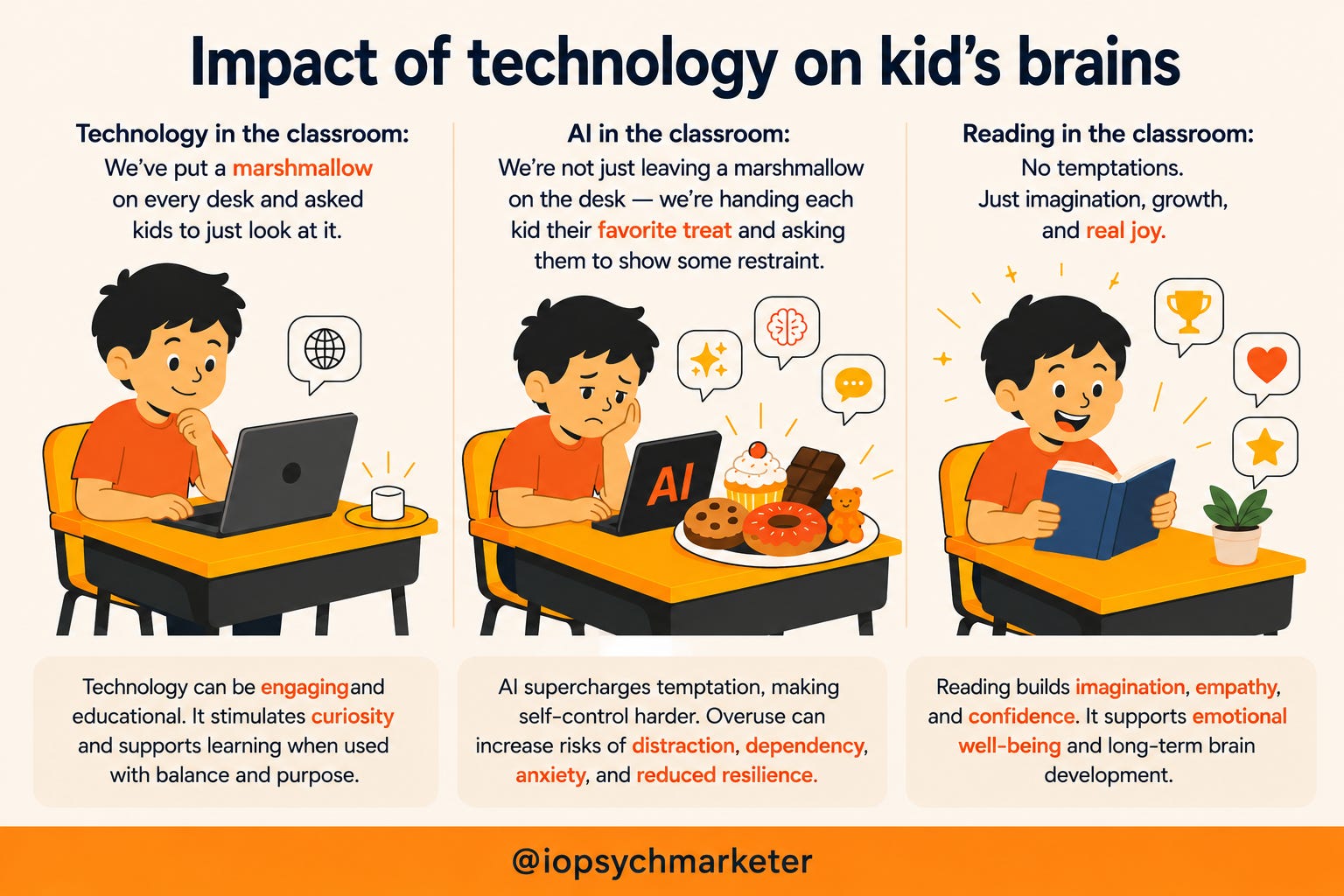
Like Walter Mischel’s “Marshmallow Test” of the 1970s, some kids have a great deal of self-control and understand the benefits of resisting temptation. Others have zero willpower and will take the easy path even knowing it’s worse for them in the long run. Mischel’s original experiment asked children to resist a single marshmallow for just 20 minutes — a difficult enough test of self-control. But allowing AI in the classroom isn’t asking kids to resist a treat for 20 minutes. It’s placing their favorite snack in front of them from the moment they wake up to the moment they go to sleep, and asking them to show restraint all day long. For kids with strong self-control, it’s an unnecessary daily battle. For those without it, it’s simply no contest.
I know I’m not alone in this fight.
What Sweden Got Right
As a parent, I battle my kids daily about homework. The argument is always the same: “I can’t do my homework without going online.” It escalates when they insist they need YouTube access for a school assignment — and when I check in, I inevitably find them in some mind-numbing corner of the internet that has nothing to do with their work.
I take comfort in what’s happening elsewhere. In 2023, Sweden reversed course on its digital education push, returning to printed books, quiet reading time, and handwriting practice, and pulling back on tablets and independent online research. Australia went further, banning social media until the age of 16. Early compliance has been a challenge — a recent National Bureau of Economic Research working paper found that nearly 75% of Australian 14- to 15-year-olds were not following the ban, driven largely by FOMO: when few of your peers seem to be playing by the rules, why would you? But the fact that governments are taking this seriously at all feels like progress.
Let’s not make the same mistake with AI that we did with our kid’s use of social media. They have plenty of time to learn AI. They only get one chance to learn how to think.