


If the Industrial side of I/O Psychology is the foundation, the Organizational side is where things get interesting. This is where we explore the psychological forces shaping our organizational cultures, our teams, and our leaders — and what actually motivates people to show up, engage, and perform. I could write for pages about each component of Org Psych (and I certainly plan to — it’s basically the entire premise of this Substack). But for today, I want to share three things that genuinely surprised me when I took my first I/O course.
LESSON ONE: There’s a lot more to motivation than Maslow
We all learned Maslow’s hierarchy of needs at some point — the famous pyramid with physiological needs at the base and self-actualization at the top. But here’s the thing: Maslow never actually envisioned it as a pyramid. That was someone else’s interpretation. And in the I/O world, it’s not even the preferred model.
Building on Maslow’s foundation, Clayton Alderfer proposed ERG Theory, which collapses the five levels into three cleaner buckets: Existence (your basic physiological and safety needs), Relatedness (your need for connection and belonging), and Growth (your drive toward personal development and self-actualization). Simpler, and arguably more practical for organizational settings.
Frederick Herzberg went in a different direction entirely with his Two-Factor Theory. He divided needs into two categories: Hygiene factors — things like salary, job security, and working conditions that, when absent, cause dissatisfaction, but when present, don’t actually motivate — and Motivators — things like recognition, meaningful work, and growth opportunities that genuinely drive performance. Herzberg’s key insight was that removing dissatisfaction and creating motivation are two completely different problems. Fixing the former doesn’t automatically produce the latter — but make no mistake, the basic hygienes are a prerequisite. You can’t inspire people who don’t feel safe, fairly compensated, or secure in their role. The motivators only kick in once the foundation is solid.
For leaders navigating AI-driven transformation, Herzberg's two-factor theory is worth revisiting. Hygienes are the prerequisite for motivation — yet in an era of monthly layoffs and AI-driven job elimination, basic job security is being systematically stripped away. You cannot motivate people who are afraid they won't have a job next quarter. The motivators don't get a chance to kick in when the foundation is on fire.
LESSON 2: Work attitudes predict performance more than most leaders realize
In my intro course, we explored how two key attitudes — job satisfaction and organizational commitment — predict employee performance. Both have been studied extensively, and both have well-documented drivers and outcomes. What struck me was that nobody seemed to have merged the two frameworks together. So I did. (See mashup graphic below).
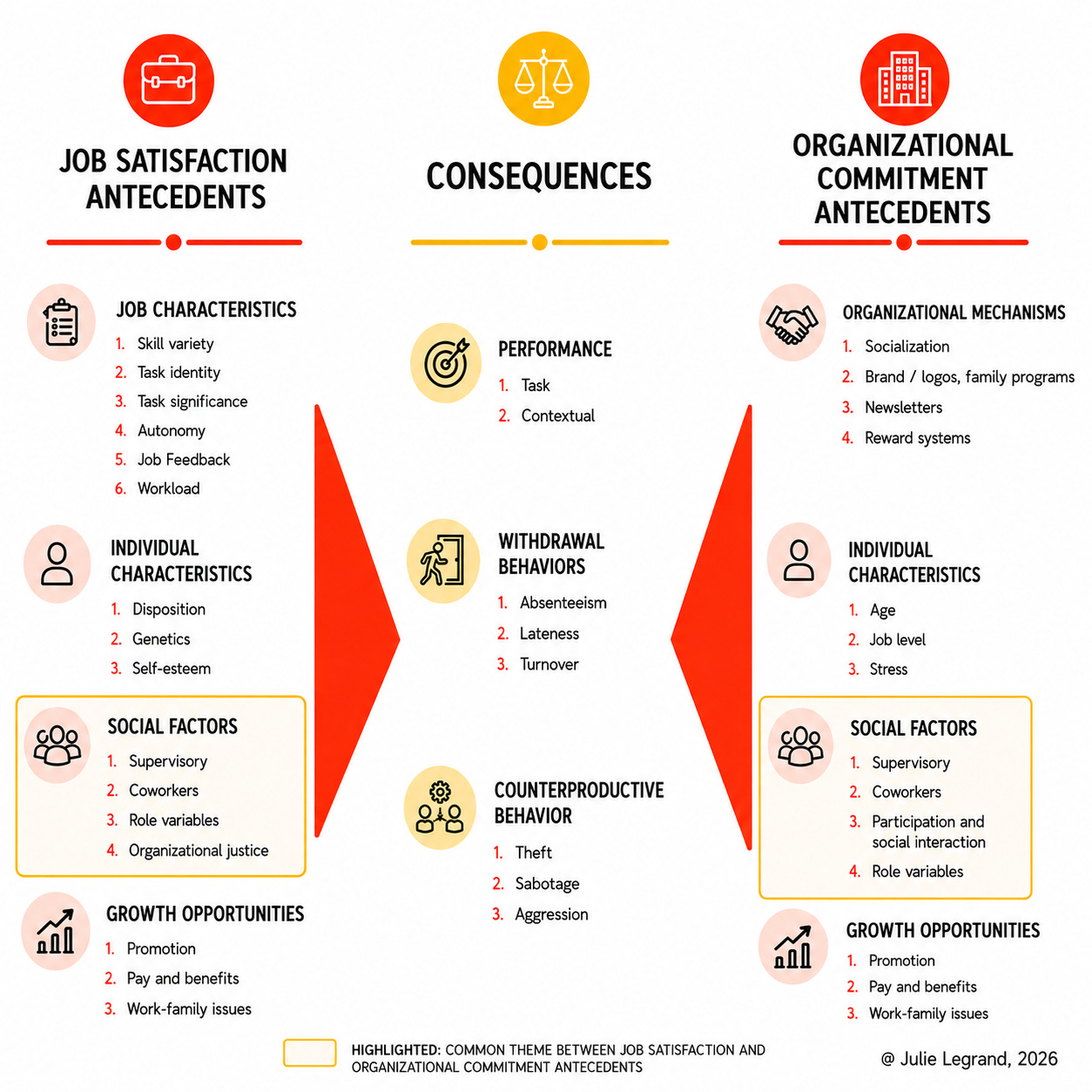
When you look at the antecedents of job satisfaction alongside the antecedents of organizational commitment, a pattern jumps out. Both are significantly shaped by the same social factors, particularly supervisory relationships, coworker dynamics and role variables. Which means that when managers invest in the quality of those relationships, they’re not just improving how people feel about their jobs. They’re simultaneously deepening employees’ commitment to the organization itself. One investment, two returns. A BOGO special, if you will.
The consequences column in the middle tells the other side of the story. When job satisfaction and organizational commitment factors are neglected — when supervisors are abusive, coworker relationships are fractured, or people lose meaning and purpose in their work — the outcomes are predictable: withdrawal behaviors like absenteeism and turnover, counterproductive behaviors like sabotage and aggression, and erosion of performance across the board.
For leaders navigating AI-driven transformation right now, this graphic is worth studying carefully. The organizational mechanisms that build commitment — socialization, recognition, reward systems, a sense of belonging — are precisely the things that get deprioritized when companies are moving fast and cutting costs. The research says that’s a very expensive tradeoff.
LESSON 3: Myers-Briggs is not what you think it is
This one surprised me most. Bring up Myers-Briggs (or MBTI) in a room full of I/O psychologists and you’ll get an earful. The core issue: I/O psychology is focused on personality traits that are stable over time and predict meaningful outcomes. And there’s substantial evidence that people’s MBTI results change — sometimes significantly — when retested. What psychologists actually use is the Big Five — also known by the handy acronym OCEAN (or CANOE, if you prefer your acronyms to float):
Openness to Experience — imagination, curiosity, and appetite for novelty. High scorers love abstract thinking and new ideas; low scorers prefer routine and practicality.
Conscientiousness — self-discipline, organization, and goal-directed behavior. High scorers are reliable and hardworking; low scorers tend to be more spontaneous and flexible.
Extraversion — sociability, energy, and assertiveness. High scorers are energized by social interaction; introverts recharge in solitude.
Agreeableness — compassion, cooperativeness, and trustworthiness. High scorers are empathetic and collaborative; low scorers tend to be more competitive and skeptical.
Neuroticism — tendency toward negative emotions like anxiety and stress. High scorers are more emotionally reactive; low scorers tend to be calm and resilient.
A note on that last one: “Neuroticism” gets a bad rap, and frankly, the name doesn’t help. But scoring high on N isn’t all bad — research shows it’s associated with increased vigilance and a heightened motivation to address potential threats. In certain roles and contexts, that’s actually a feature, not a bug.
If you want to find out where you land, there are several accessible assessments available — Truity offers a free basic version, and personality.co has a detailed report for a couple of dollars. If you want to go even deeper to understand how personality affects your team, organizations such as Lumina Learning offer more in-depth assessment tools, training and resources to help organizations fully leverage the strenghts of each team member’s unique personality traits.
More to come
This is genuinely the tip of the iceberg in the fascinating field of Organizational Psychology. Leadership, group dynamics, culture, organizational design, and a lot more on motivation — each of these deserves its own deep dive, and I plan to give them one. If there’s a topic you’re particularly curious about, drop it in the comments. I’d love to know what’s most relevant to what you’re navigating right now.
References:
Alderfer, C. P. (1972). Existence, relatedness, and growth : human needs in organizational settings. Free Press.
Herzberg, F. (1966). Work and the nature of man. World Pub. Co.
Levy, P. E. (2025). Industrial/organizational psychology: Understanding the workplace (Seventh). Worth Publishers, Macmillan Learning.
Maslow, A. H. (1943). A Theory of Human Motivation. Psychological Review, 50(370–396).