


Recently a new manager I’m coaching — let’s call her Jennifer — asked me a simple question: “Where’s the training to teach us new managers how to manage our teams?”
My answer was pretty brutal: there really isn’t any. Although her company offers hundreds if not thousands of on-demand modules in its learning portal, not a single person could tell her which ones actually mattered. Her manager’s advice was: “Sorry, I don’t have time to go through the catalog with you. I think you should focus on your project management and leadership skills. Good luck!”
The thing is, Jennifer had already taken a lot of the leadership courses in that portal — they’re required for everyone in the company. But since she never had a chance to apply the skills afterward, they went in one ear and out the other.
I wish I could say that was unusual.
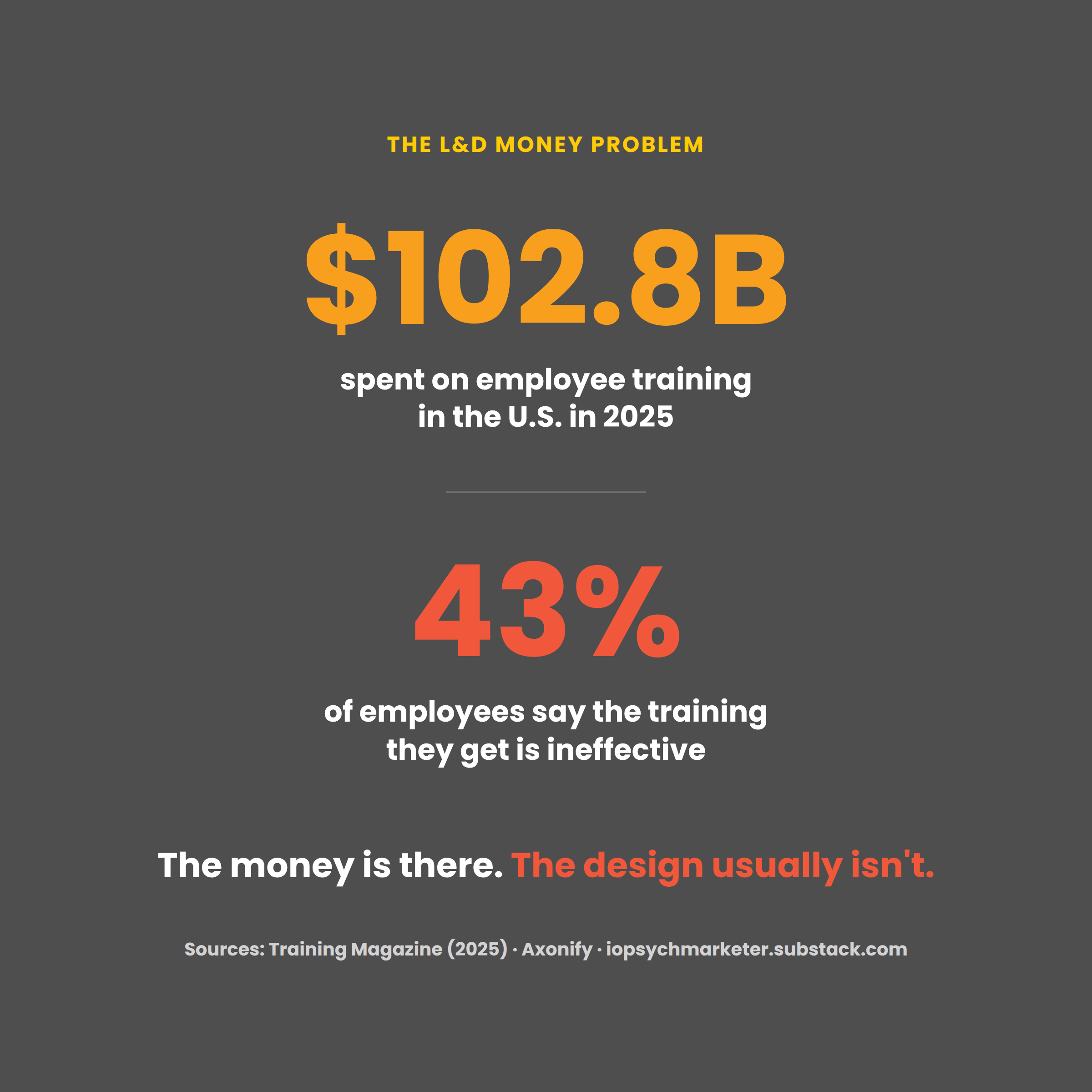
The reality is there’s almost too much training out there, and not enough development. U.S. training expenditures jumped 4.9% to $102.8 billion in 2025, and the top 125 companies averaged $145.5 million in training budget alone (Training Magazine, 2025). More than 90% of Fortune 500 companies run some kind of formal training program, spending an average of $1,270 per employee annually. While the companies with formal training programs enjoy 2.1x higher revenue per employee than those without do consistently outperform the ones that don’t (Walsh, 2026), however 43% of employees say the training they get is ineffective (Axonify, n.d.). The money is there. The design usually isn’t.
How I learned to learn
Jennifer is proof of that at the individual level. I’m proof of it too — because long before I was coaching people through this problem, I was living it myself, on the other end of a very expensive lesson nobody had bothered to teach me.
I was 28, a year out of business school, all ego and ambition, when I got my first team: three associates and a 30-day deadline to build a competitive analysis that would either win us a multi-year transformation engagement or hand it to a competitor. No pressure.
The team fell apart almost immediately. They didn’t have the skills the work required, and when they couldn’t deliver, I did what a lot of first-time managers do: I stopped delegating and just did the work myself. I soon found myself out the door by 6am and home past midnight — sometimes 1 or 2am — for a month straight. I ran the project into the ground trying to carry it alone, and I ran myself into the ground right along with it.
Somehow I survived that month and pulled off a pretty impressive analysis, which I got to present to the client at their offices in Geneva. Not only did the trip come with a very fun ski ⛷️ detour, it also led to millions of dollars in add-on work. Win-win, in my book. But that’s survivorship bias talking. Had I crashed and burned instead — which was very much the more likely outcome — the firm could have lost millions had I failed to deliver. Nobody had set me up to succeed. I just happened to.
Afterward, in the debrief, I admitted to some of the firm’s senior leaders how close to the edge that project had actually been because I had no clue how to manage my team. That admission got me pulled off client work and handed one of my favorite projects ever: working with the L&D team to build new-manager training program built so other young managers wouldn't be one bad month away from the same disaster. This was back when organizations still had the patience for that type of investment. My new L&D friends and I spent a month building a 3-day in-person curriculum that included best practices and role-plays for the moments no one prepares you for (an employee breaking down about a personal crisis, a teammate quietly checking out, a peer who resents reporting to you now). We didn’t stop at the classroom, either — participants came back together over several months afterward to work through what was actually happening on the job.
That program worked. We got rave reviews from the new managers, and it was rolled out firmwide. What’s remarkable is that the lessons I learned building it have stayed with me my entire career and there are techniques I still use today that trace straight back to that program. Which is really the point: it was a learning program, not a training class, and the difference showed.
What “Learning” Actually Means
Here’s where many people get it wrong: they treat training and learning as the same thing. They are not.
Learning is defined as “a relatively permanent change in behavior that results from experience.”
Training is one input into that — and a small one at that. Treating it like the whole equation wastes money and leaves people like Jennifer sitting through training that goes in one ear and out the other.
Gallup’s (n.d.) research on high-development workplaces backs this up with real numbers: organizations that invest strategically in employee development see 11% greater profitability and are twice as likely to retain their people. But “investment” doesn’t mean a bigger course catalog.
70-20-10 Framework
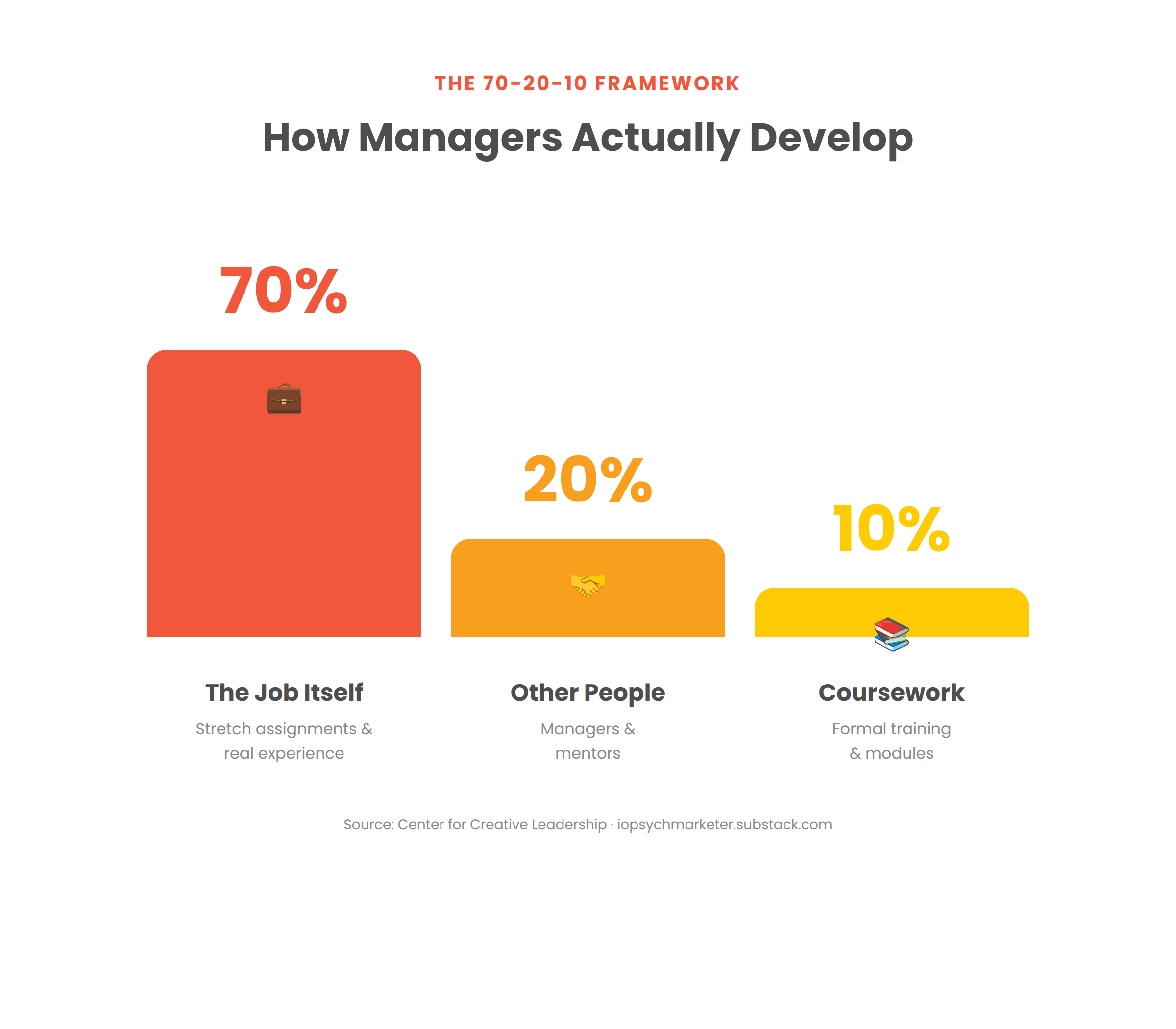
Most companies are pouring their L&D budget into the smallest slice of the pie. The Center for Creative Leadership’s (CCL, n.d.) classic 70-20-10 framework puts it plainly — only about 10% of how people actually develop comes from formal coursework. 20% comes from other people. The remaining 70% comes from on-the-job experience: stretch assignments, hard projects, real consequences.
The 10%: Coursework
A LinkedIn Learning or Coursera subscription is not a development strategy — it’s a library card. Without someone to help an employee figure out which ten courses out of ten thousand actually move the needle for their role and their gaps, the subscription is just a line item that looks good in a board deck and does almost nothing on the ground. Jennifer’s stack of completed-but-unused leadership modules is exactly this problem in miniature.
The 20%: Other People
If you’re lucky, you had a great manager early on and you absorbed their instincts by osmosis. If you weren’t lucky, you’re not doomed — but you do need someone actively filling that gap, which is what real mentorship programs are for. According to WorldMetrics (2026), 92% of employees learn critical skills faster with a mentor, mentored individuals are 78% more likely to land senior roles within five years, and companies with mentorship programs see 50% higher employee retention, a 50% boost to organizational learning, and a 35% lift in innovation.
The 70%: The Job Itself
This is the part almost nobody formalizes, and it’s the part that actually shapes managers. It’s not that you can’t develop without a strong manager or a mentor — it’s that you’re competing against people who had one, and stretch assignments handed out with intention beat stretch assignments you back into by accident.
The scale of what’s at stake here is real money, not soft-skills theater.
What Actually Works
L&D Strategy
Before you touch a single module, get the structural non-negotiables right — this is the part of the academic literature most companies skip entirely:
Diagnose before you build. Don’t design training and then go looking for a problem it solves. Run a real needs analysis first, at four levels: organizational (what does the business need), task (what does the role require), person (who has the gap), and demographic (are certain groups systematically underserved).
Train to competencies, not topics. Decide what you actually want every employee to be able to do, then build the program around those specific competencies — not around whatever course happened to be trending.
Time it to the moments that matter. Development isn’t evenly distributed across a career — it’s concentrated at a handful of lifecycle moments: onboarding, ongoing capability building, the follow-up after a hard performance conversation, and promotions or job changes. Miss those windows and the rest of the calendar is mostly noise.
5 Principles of Training Development
Once the strategy is right, the design itself isn’t guesswork either — it’s an actual playbook. Kraiger and Ford’s 2021 review of the science of workplace instruction distills it into five principles:
1. Organize the content. Good training has coherence — the ideas connect to each other instead of sitting as a loose pile of slides — and contiguity, meaning related concepts show up close together in space and time rather than scattered across the deck. It also front-loads an advance organizer: a short preview that tells learners what’s coming and how it fits together, before they’re in the weeds of it.
2. Sequence the material deliberately. Start simple and scaffold — give heavy support early, then pull it back as competence builds. Increase difficulty adaptively, so people spend the right amount of time at each level of mastery instead of racing ahead or stalling out. And interleave: mix different types of problems or skills within a session rather than drilling one thing in isolation, because switching between related skills is what actually builds transferable judgment.
3. Make the learner do the work. This is the generative-effects principle — people retain what they actively connect to what they already know, not what they passively absorb. Build in prompts that trigger metacognition, so learners are questioning their own strategy as they go, not just executing steps. And use retrieval practice — repeated recall of the material — which cements it in long-term memory far better than re-reading or re-watching ever does.
4. Practice under real conditions. Vary the practice across different tasks, people, and situations rather than one clean scenario. Space it out over time instead of cramming it into a single session. And use the identical-elements principle — put learners in situations that look and feel as close as possible to the actual job, because the closer the practice mirrors the real thing, the more likely it survives contact with Monday morning.
5. Push past mastery. Give learners knowledge of results — a clear signal of whether the response was right or wrong, and what the correct one actually is, so they’re not moving on with a false sense of competence. Layer in feedback and feedforward — communication aimed specifically at modifying behavior, not just scoring it. And don’t stop at “good enough”: overlearning — continued practice past the point where someone first hits mastery, through repeated drills or refreshers — is what makes a skill survive weeks or months without use, instead of evaporating the moment training ends.
You don’t have to reinvent the wheel here, and you don’t have to build every piece of content from scratch. But you also can’t do what Jennifer’s employer did and just “wish her luck.” There’s a huge amount of good off-the-shelf content out there — the opportunity is building a hybrid approach: take what already exists, sequence and structure it properly, and give learners real opportunities to apply it, under real conditions, over time.
None of this is a complicated. It’s just rarely done on purpose.
References
Axonify. (n.d.). Axonify finds no improvement in corporate training: Second annual state of workplace training study. https://axonify.com/news/axonify-finds-no-improvement-corporate-training-second-annual-state-workplace-training-study/
CCL. (n.d.). The 70-20-10 rule for leadership development. Center for Creative Leadership. https://www.ccl.org/articles/leading-effectively-articles/70-20-10-rule/
Gallup. (n.d.). What high-performance workplaces do differently. Gallup Workplace. https://www.gallup.com/workplace/269405/high-performance-workplaces-differently.aspx
Kraiger, K., & Ford, J. K. (2021). The Science of Workplace Instruction: Learning and Development Applied to Work. Annual Review of Organizational Psychology and Organizational Behavior, 8(1), 45–72. https://doi.org/10.1146/annurev-orgpsych-012420-060109
Johansson, E. (2026, February 12). Mentorship statistics. WorldMetrics. https://worldmetrics.org/mentorship-statistics/
Training Magazine. (2025). 2025 Training Industry Report. https://trainingmag.com/2025-training-industry-report/
Walsh, T. (2026, February 12). Training statistics. WorldMetrics. https://worldmetrics.org/training-statistics/