


At some point in your career, someone hands you a team and says: figure it out.
No framework. No training. Just a headcount, a mandate, and the expectation that you’ll know how to structure the work. And most of us do what I did for years — we reach for instinct. We think about who’s good at what, draw a few boxes on a whiteboard, and call it an org chart.
Then something breaks. A reorg. A hypergrowth moment. A layoff that cut the team in half. A team that suddenly doubled in size.
That’s exactly what happened to me. Once after a reorg, I inherited a large team with no obvious structure. And for the first time, my instincts had nothing to say. So I went looking for answers.
What I found sent me down a rabbit hole so deep it eventually led me to Harvard and a deep dive into organizational behavior, org design, and industrial psychology — fields that as a GTM leader I hadn’t much thought about since business school. Turns out, org design is an entire field — rich, rigorous, and almost completely absent from most leadership developments programs.
We teach leaders how to manage people. How to run a P&L. How to build strategy. But we don’t teach them how to design the very structures to get the work done.
The simulation that humbled a class full of Harvard students
One of the most enlightening (yet humbling) moments of my program thus far was in my Organizational Behavior class with the iconic Professor Lee Bolman. Anyone who’s taken his course will tell you it’s a magical experience. Professor Bolman has been teaching since 1969 and is half of the duo — along with the late Terry Deal — behind the classic textbook Reframing Organizations (2021), now in its eighth edition. The book explores organizations through four lenses, or “frames”: Structural, Human Resource, Political, and Symbolic.
In his class, we participated in a simulation where we had to redesign a fictional org structure as our company scaled. We got three attempts. No one succeeded on the first try. More than half of us never reached the optimal design at all (myself included).
That’s not a failure of intelligence. It’s simple the nature of org design which is difficult, iterative, and full of tradeoffs. No structure is universally right or wrong. But some are far better than others.
So what does good org design actually involve?
Bolman grounded us in a foundational insight from Alfred D. Chandler Jr., the Harvard historian whose landmark 1962 book Strategy and Structure studied General Motors, DuPont, and Standard Oil to reach a deceptively simple conclusion: structure follows strategy. Before you can design the right org, you have to be clear on what you’re trying to accomplish. A structure that served your old strategy may actively work against your new one.
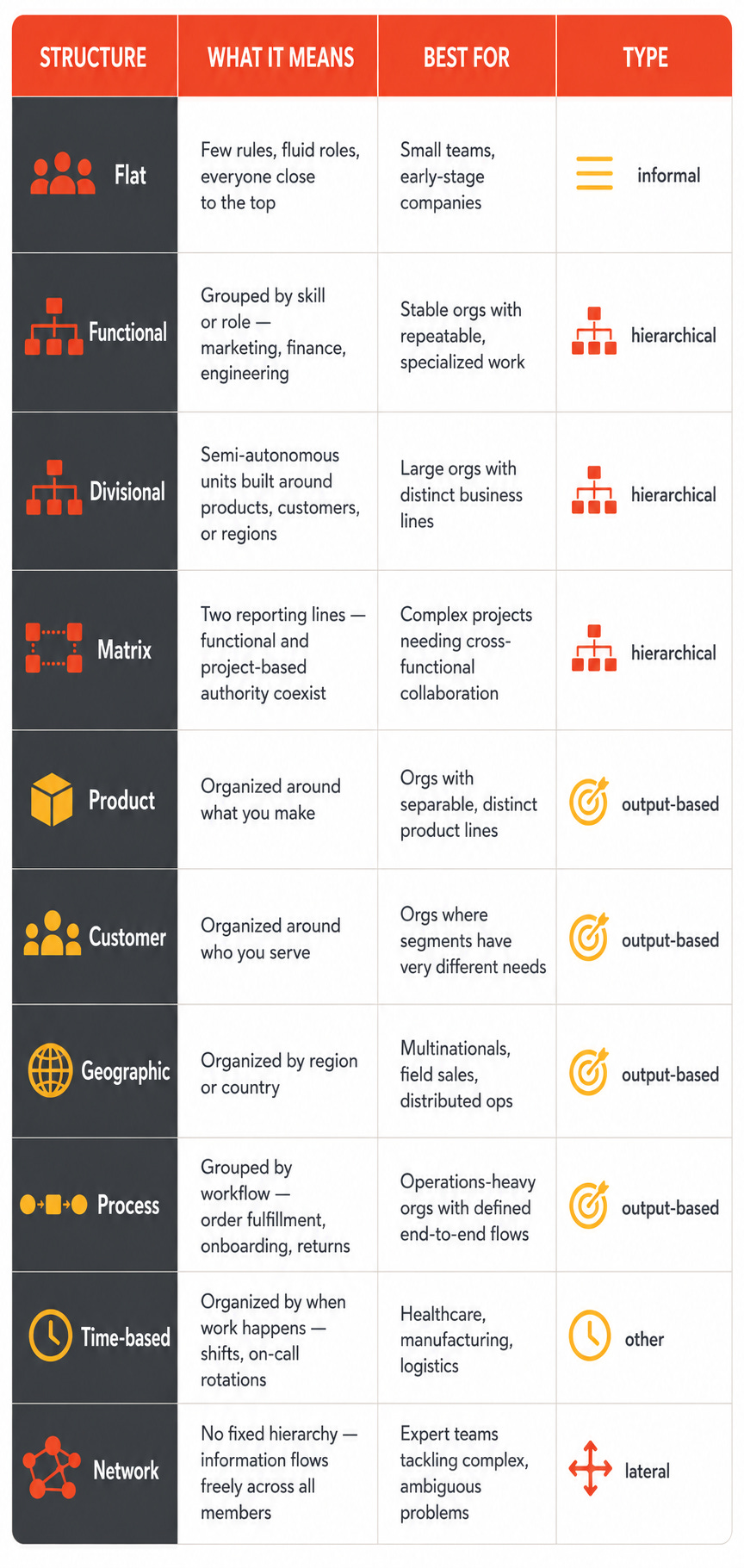
Structure isn’t just one thing. Depending on what you’re trying to accomplish, you might organize by function (what people know), by product (what you make), by customer (who you serve), by geography, by process, or by time. Each model carries different tradeoffs.
At one end of the spectrum, you have direct hierarchical chains of command — efficient in simple, stable environments. At the other, all-channel networks where information flows freely across the whole team — powerful for complex, ambiguous work, but slow when you need fast decisions. Most real organizations need something in between, and the calibration matters enormously.
The table below is a cheat sheet of the typical options.
Can’t reach your boss? You’re not alone.
Another crucial concept in org design centers around span of control — a challenge facing many stretched leaders today who feel something is off but can’t quite name why. You’d think most leaders would be thrilled with bigger teams. More people, more output, right? But most often, bigger teams are harder. And there’s a good reason why, when you look at it through a behavioral science lens.
The WSJ recently reported that the ratio of employees to managers has nearly tripled since 2017 — from 5:1 to 15:1 — and it’s still climbing. The headline said it all: Your Boss Doesn’t Have Time to Talk to You (2025). And yet this contradicts everything we know about team effectiveness.
OB researcher J. Richard Hackman was characteristically blunt about it: “A rule of thumb I relentlessly enforce … a team cannot have more than six members.”
Hackman and many other behavioral scientists have demonstrated again and again that productivity gains from teamwork tend to decline as teams grow too large and cumbersome — yet organizations keep moving in the opposite direction.
What are the consequences of this disconnect? When a manager is stretched too thin, decisions slow down or go sideways. Add a layer of management and you gain bandwidth, but lose access and speed. The right design isn’t a formula — it’s a function of complexity, volatility, and the nature of the work itself.
The messy truth about change
Here’s what Professor Bolman taught us that I keep coming back to: no structure is right for all times and circumstances. When your strategy shifts, your structure needs to shift too — Chandler’s logic playing out in real time.
And yet many leaders treat org design like a one-time event — something you do after a reorg and then don’t touch for three years. Others swing to the opposite extreme, constantly reshuffling structures and leaving people disoriented in the process. Like the simulation, there’s no perfect answer. But there are good ones and bad ones.
Professor Bolman was brutally honest about why this is hard: you can’t fully know if a new structure will work until you try it. Things usually get worse before they get better. And every structural choice involves tradeoffs.
That’s not a reason to avoid the work. It’s a reason to take it seriously — to learn the theory, lean on the models, and bring in org design experts when the stakes are high. There are a lot of great ones out there, and this is exactly the kind of problem they exist to solve.
Leaders deserve better Org Design resources
We’ve spent decades investing in leadership development and almost none of it covers this. We promote people into roles that require them to architect teams, and then leave them to figure it out by feel.
When those teams underperform, we diagnose the people. We rarely diagnose the structure.
Org design isn’t magic, but it’s not someone one should attempt without understanding the models and principles of the field. The leaders who treat it that way build better teams. The ones who rely on instinct alone? Let’s just say they may not pass Professor Bolman’s class.
Have you ever inherited a team with no roadmap for how to structure it — or watched a well-intentioned reorg make things worse before anyone admitted it wasn’t working? I’d love to hear from you in the comments.
References
Bolman, L. G. (with Deal, T. E. & ProQuest). (2021). Reframing organizations: Artistry, choice, and leadership (7th edition.). John Wiley & Sons, Inc.
Hackman, J. R. (with Harvard Graduate School of Business Administration). (2006). Leading teams: Setting the stage for great performances (Nachdr.). Harvard Business School Press.
Your Boss Doesn’t Have Time to Talk to You -- WSJ. (2025, August 29). Dow Jones Institutional News.