


Across history, women account for only about 3% of eminent creative contributions, the kind that redefine a field (Simonton, 1994).
Last week I ran a LinkedIn poll suggested by my Creativity professor, Dr. Shelley Carson (2026), asking what best explains the gender gap in big-C creativity. 50% of you said sociocultural, 37% said a mix of all three, 12% said personality, and 0% said biological (good job). I think the wisdom of the crowd is (mostly) correct. Studying under Dr. Carson, one of the foremost scholars in the field of creativity, is a priviledge of a lifetime, and each week she finds a new way to reshape how I think about who achieves creative greatness, and why.
That question she posed feels more urgent in the age of AI. We’re generating new things at an unprecedented pace, but AI learns from what history has already recognized as creative, a record written overwhelmingly by men. If we want genuinely new ideas rather than anodyne slop, it helps to understand who was left out of that record, and why.
Here’s what I’ve learned about gender and creativity. Explanations generally fall into nature or nurture. The nature view holds that evolution favored men as creators and leaders. The nurture view holds that society assigned men those roles and steered women toward domestic ones. Both have been used to argue that men are “superior.” Only one holds up well.
Dr. Carson shared 3 arguments that have been suggested that explain this gap.
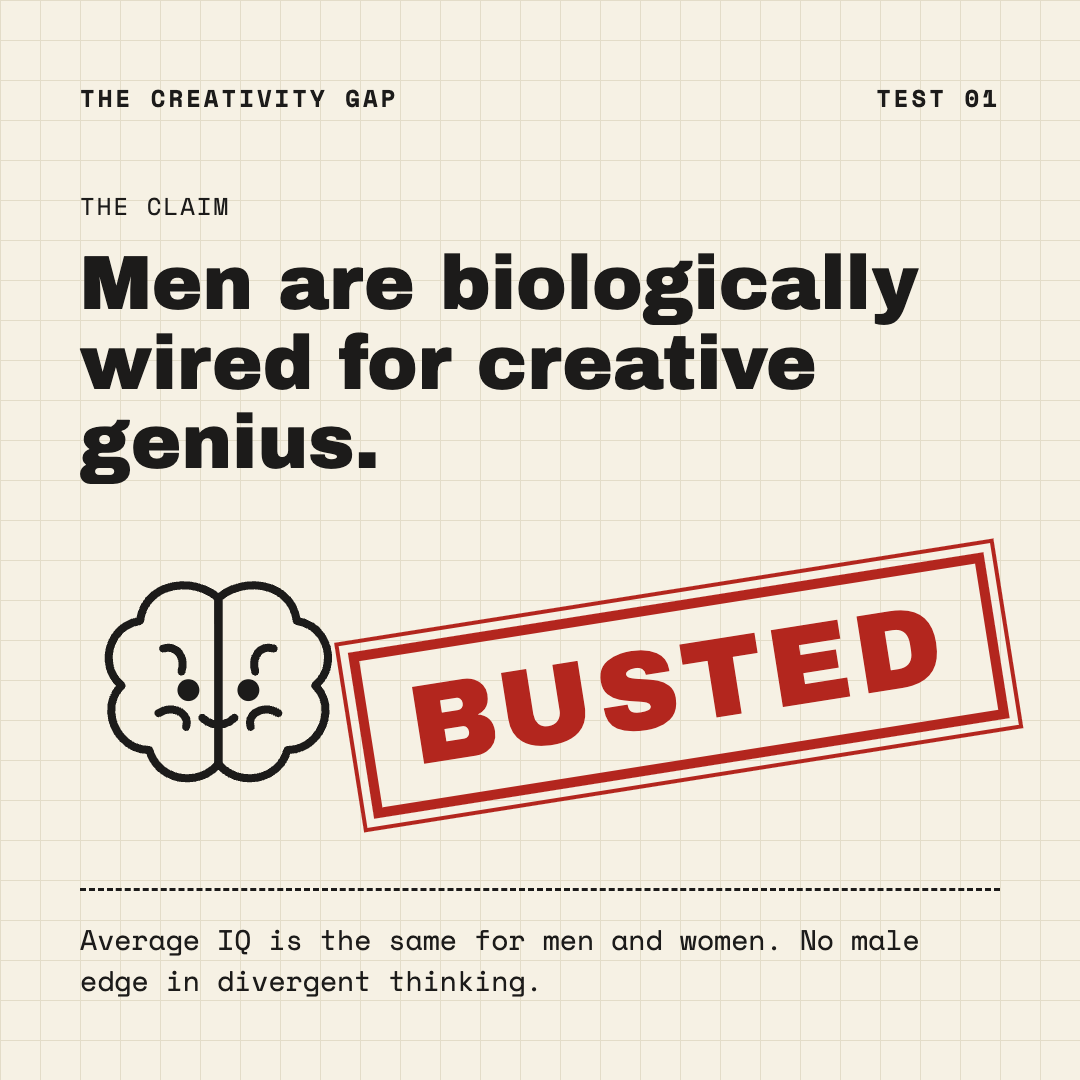
Biology: the weakest explanation
The oldest claim is that men are simply more capable: stronger, smarter, more driven. Men are physically stronger on average, but that’s where the evidence stops. Average IQ is the same for men and women, and there’s no male advantage in divergent thinking, the ability to generate many original ideas that are closely tied to creative potential.
A more serious version of the argument is variability. Men’s IQ scores are more spread out than women’s, so more men land at both the very top and the very bottom. That could put more men in the extreme upper tail. But threshold theory weakens this: above an IQ of roughly 120, extra intelligence has little relationship to creative achievement. And whether men show the same extra variability on creativity measures is much less clear.
Brain research shows some small sex differences, but none that come close to explaining a creative gap of this size. There is no conclusive evidence of female inferiority in intellect or creative ability. At most, men may be overrepresented in the extreme tails of a few contributing factors.
Verdict: To borrow the verdicts from one of my kids’ favorite science shows, this claim is “busted.”
Personality: real differences, modest effects
Here the research finds genuine average differences in traits that matter for creative output:
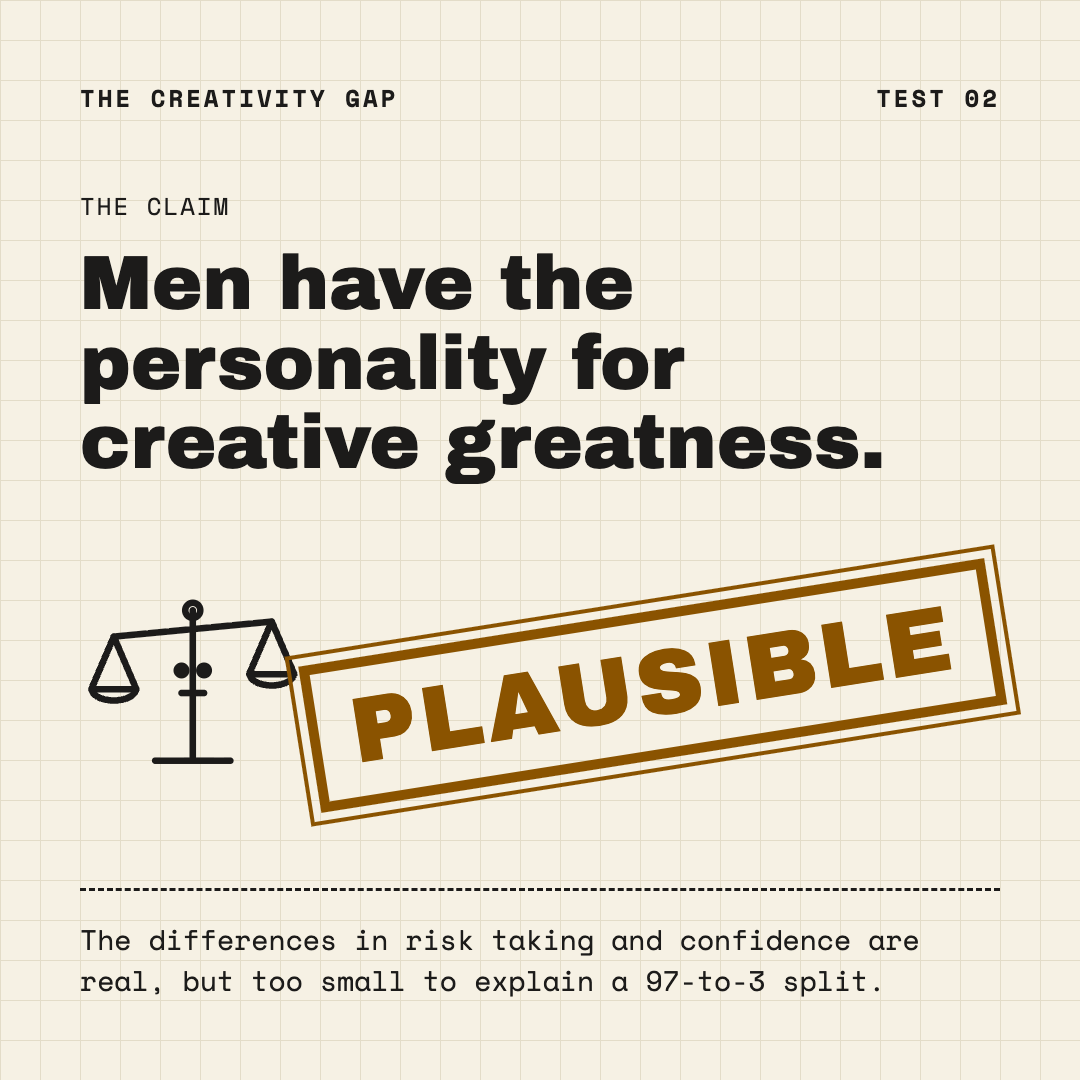
Risk taking. Women take fewer risks than men on average (Byrnes et al., 1999; Harris & Jenkins, 2006). But the overall difference is small, with heavily overlapping distributions.
Agreeableness. Women score higher, with a stronger drive to please others (Weisberg et al., 2011). Highly creative people tend to be less agreeable, willing to reject consensus and frustrate people.
Self-perception. Women are more self-effacing, while men are more confident and self-assertive (Barron, 1972).
These differences are real. But each is modest, and it’s worth asking how many are themselves products of socialization. Small average differences in personality cannot plausibly produce a 97-to-3 split.
Verdict: plausible. The differences are real, but too small to explain the gap on their own.
Sociocultural factors: where most of the gap lives
This is where Dr. Carson suggests the evidence is strongest, and there are many factors driving it.
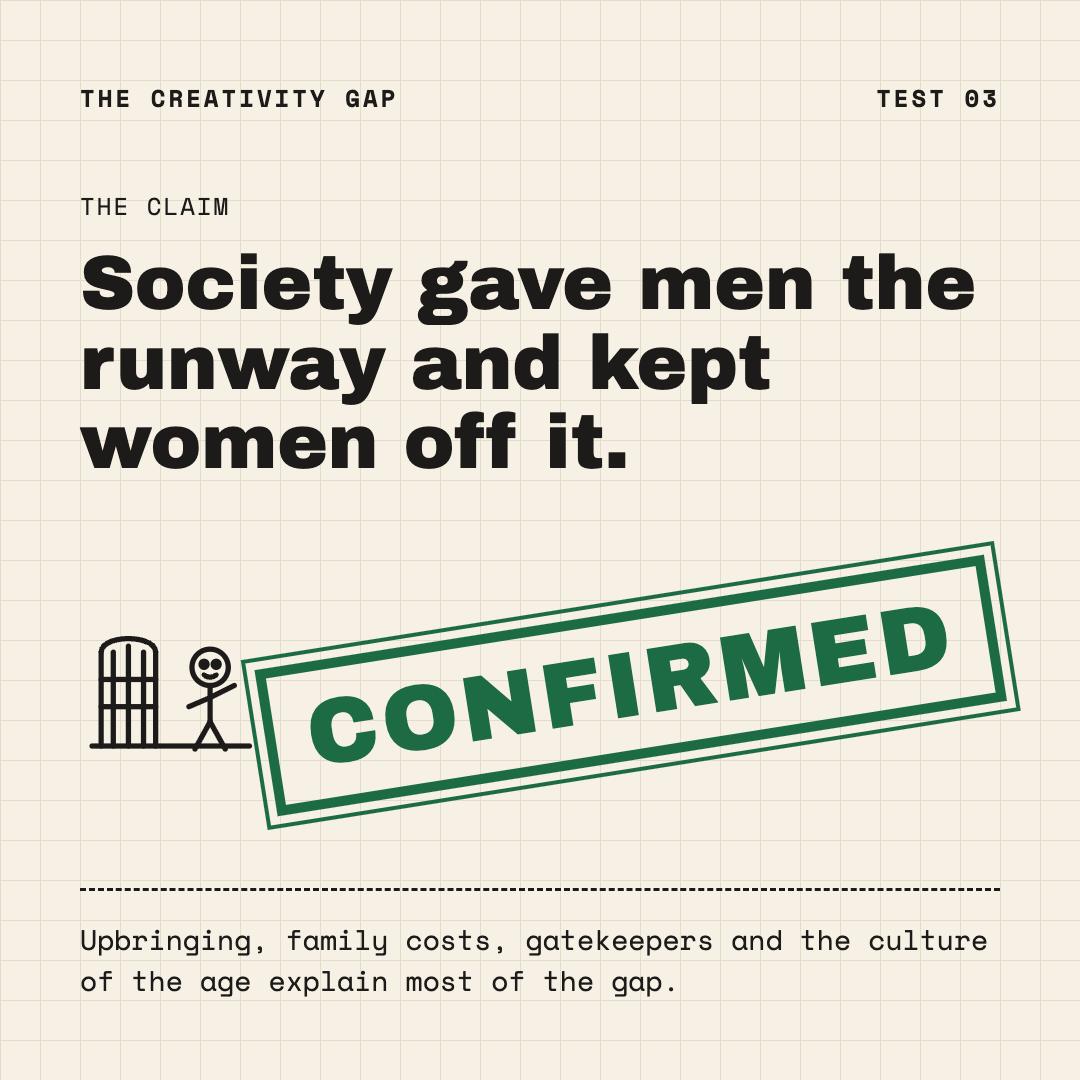
How we raise children. Boys are socialized toward independence and achievement, while girls are socialized toward caring for family and relationships. Many talented women don’t pursue goals outside the home until family needs are met. When family resources are limited, they’ve tended to flow to sons. Helson’s (1990) longitudinal research on Mills College women traced how these expectations shaped women’s creative careers.
This one hits home. My mother grew up in an Irish Catholic family of eight kids in 1950s North Philly, the home of Tastykakes and “wooder.” All three boys were sent to elite four-year colleges. The five girls were lucky to attend nursing or secretarial school, and all had families of their own by 24. Some of my aunts later took their fates into their own hands, finishing degrees and even earning law degrees and PhDs, but that came from their own sheer determination rather than family support. It’s not that my grandparents didn’t love and support them; the idea of a girl doing anything besides caring for a husband and children was simply foreign.
The cost of family. Highly creative women have historically tended to avoid family responsibilities. Women in Who’s Who are about four times more likely than men to be unmarried and successful women who marry are less likely to have children than equally successful men (Hopcraft, 2024). Only women have been forced to choose between productive and reproductive success.
Sounds about right. Early in my consulting career, I had lunch with several other female consultants, commiserating about how we could ever do this job and raise a family. We could count the female partners at the firm on one hand, and we noticed they had one thing in common: they either had no kids or had stay-at-home husbands. Things have changed since then, but not as much as we’d like to think.
Oversocialization. Some researchers argue women are “oversocialized” to prioritize the well-being of the group over individual ambition (Helson, 1990). Notably, gender-raising practices vary across cultures, which is hard to square with a purely biological explanation.
Gatekeeping. Creative fields are judged by gatekeepers who decide what gets in, and historically those gatekeepers were men. Marie Curie won the Nobel Prize in Physics in 1903, yet in 1911 the French Academy of Sciences rejected her for membership. That same year, she won her second Nobel, in Chemistry.
Women have historically fared better in literature, and for a telling reason. Unlike science or art, writing required no lab, studio, or block of marble, and so no funding or sponsor. A woman could also publish under a pen name, so the field never knew her gender. Even then, recognition often came late. Fewer than a dozen of Emily Dickinson’s poems were published in her lifetime. She wrote nearly 1,800, and today she’s considered one of the most important American poets (Carson, 2026).
The zeitgeist. The political and religious climate of an era can bar women outright. Across history, many cultures and traditions have restricted women’s education, required their obedience to husbands, or treated them as dependents.
Verdict: confirmed
So is it a mix of all three?
In a sense, yes, and that’s a fair answer. But the three don’t carry equal weight. Biology explains very little. Personality explains some, and part of that may be learned rather than innate. Most of the gap is explained by differences in parental treatment, societal expectations, the demands of family life, discrimination within fields, and the cultural climate of the time.
Why this matters at work
The creative luminaries who made history and the executives who run companies today got there through the same doors: someone opened a gate, forgave a risk, sponsored an unproven idea, or simply invited them to the golf course. Those forces still shape who reaches the top. Women still only hold 29% of C-suite roles, a share that has stopped climbing (McKinsey & Company & LeanIn.Org, 2025), and even worse, just about 11% of Fortune 500 CEO seats (Fortune, 2026).
The pattern is even sharper in the startup world. Startups with at least one female founder received just 19.9% of U.S. venture capital in 2024 (PitchBook, 2025). Those founded only by women received about 2% in 2023 (SSTI, 2024). Investors are gatekeepers too, and their choices shape which ideas get built and which never leave the whiteboard.
I’ve seen these subtle exclusionary practices in my own career as well. Not overtly banned, but quietly excluded. As a young consultant in the St. Louis office, I learned that the executives did their real business on the golf course. I had no interest in the sport, but I took lessons anyway to try to join them. I was so bad that it only proved I wasn’t cut from the same mold. The inner circle stayed closed. No rule kept me out. The gatekeeping just moved to the fairway.
We’ve come a long way but the sociocultural mechanisms have not disappeared. They moved inside organizations, and today’s gatekeepers are often people who would never think of themselves that way. Who gets the stretch assignment? Whose failed bet is forgiven? Whose unconventional idea is called visionary and whose is called risky? Who carries the caregiving load that quietly caps their output? The research suggests creative capacity is evenly spread. What isn’t spread evenly is access through the gate. And as AI increasingly shapes what gets made, every talented person left outside it is a cost that compounds.
Who are the gatekeepers in your organization, and who are they letting in? I’d love to hear in the comments.
References
Barron, F. (1972). Artists in the making. Seminar Press.
Byrnes, J. P., Miller, D. C., & Schafer, W. D. (1999). Gender differences in risk taking: A meta-analysis. Psychological Bulletin, 125(3), 367–383.
Carson, S. (2026, September 30). Gender differences in creativity [Course presentation]. Psychology E-1704, Harvard Extension School.
Fortune. (2026, June 3). Women run a record 11.2% of Fortune 500 companies in 2026. https://fortune.com/2026/06/03/how-many-women-are-fortune-500-ceos/
Harris, C. R., & Jenkins, M. (2006). Gender differences in risk assessment: Why do women take fewer risks than men? Judgment and Decision Making, 1(1), 48–63.
Helson, R. (1990). Creativity in women: Outer and inner views over time. In M. A. Runco & R. S. Albert (Eds.), Theories of creativity (pp. 46–58). Sage.
Hopcroft, R. L., Fieder, M., & Huber, S. (2024). Not so weird after all: The changing relationship between status and fertility. Routledge. https://doi.org/10.4324/9781003463320
McKinsey & Company & LeanIn.Org. (2025). Women in the workplace 2025.
PitchBook. (2025). 2024 US all in: Female founders in the VC ecosystem. https://files.pitchbook.com/website/files/pdf/2024_US_All_In_Female_Founders_in_the_VC_Ecosystem.pdf
Simonton, D. K. (1994). Greatness: Who makes history and why. Guilford Press.
SSTI. (2024). Useful stats: Female founders and VC, an overview. https://ssti.org/blog/useful-stats-female-founders-and-vc-overview
Weisberg, Y. J., DeYoung, C. G., & Hirsh, J. B. (2011). Gender differences in personality across the ten aspects of the Big Five. Frontiers in Psychology, 2, 178.
Leadership in medicine and healthcare is not different. Women have made some strides, but not enough. This is true even in pediatrics where there are far more women in the field in general, but it does not yet carry through to the upper levels.
I feel so much of this so deeply. Thank you for putting this research out there!