


Last weekend I attended Harvard vs. Colgate as part of my Harvard Extension School Convocation week.
The stadium wasn’t full. Honestly, it had the feel of a high school game, just with a jumbotron and a full cheer and dance team. I was there with a big group, including a friend who works for the NFL and knows more about football than anyone I know. By the final minute, we were mesmerized. It felt like we were watching history.
If you don’t follow football, here’s the setup: Harvard had the lead late in the fourth quarter when Colgate scored a touchdown to go up by 3 with 27 seconds left. I turned to my NFL friend: “Okay, this is over.” She said crazier things have happened. She did not look hopeful.
Then Harvard marched down the field to the 33-yard line, close enough for a field goal to tie with 4 seconds left. And then: a false start. The penalty pushed Harvard back out of field goal range. The crowd was deflated. The guy next to me predicted that the player would be riding the bench for weeks.
But Harvard didn’t give up. From 44 yards out, they threw a Hail Mary, caught it in a crowd, and pitched a lateral to a freshman who dove into the end zone. Final: Harvard 20, Colgate 17. ESPN played it all weekend and it was picked up by the New York Times.
“This is why football is so exciting,” my friend said. “You never know what’s going to happen.”
Except, it turns out, the Crimson coach did.
The miracle was on the practice schedule
The Wall Street Journal followed up and found the play was by design, not by accident.
Head coach Andrew Aurich, 43, played at Princeton and worked his way up as an assistant from Division III to the NFL. Under Greg Schiano (who learned it from Bill Belichick), he absorbed the gospel of “situational football”: a game lasts 60 minutes, but a handful of seconds at the crucial moments decides the outcome.
So every week, Aurich turns part of practice into a lab for the worst case. He puts 60 seconds on the clock, takes away every timeout, and makes the offense drive the length of the field to win. He’s built a specialized playbook just for covering a lot of ground with almost no time. In his three seasons in Cambridge, Harvard has won five games with scores in the final minute, three of them with time expired.
The play that beat Colgate is called “Big Ben.” A 6-foot-6 tight end, Teigan Pelletier, catches the ball in a crowd while four teammates circle him in a diamond, ready to grab a deflection or take a lateral. Harvard had run it in practice the day before, and Aurich reminded his players of exactly that before the snap. Freshman receiver Nate Bailey took the lateral, just as he had on so many Fridays, and scored.
Aurich’s explanation for why his team stays calm when the whole stadium has given up: “We do it every week, multiple times a week, so there’s no panic.”

So what does this have to do with I/O psychology?
Training.
Specifically, training for the things that are unlikely to happen but change everything when they do. It’s the difference between a lost cause and a team that has already rehearsed the miracle.
Right now, in the middle of AI-driven transformation, training is often the first thing to go. Or it gets reduced to generic on-demand modules instead of the kind of practice that becomes a strategic advantage. Things are moving so fast that many organizations aren’t building training at all. People are expected to figure out new tools, new workflows, and sometimes entirely new jobs on the fly.
The research is pretty clear about what that does to people.
What happens when people stop feeling competent
Arjan van Dam, Gera Noordzij, and Marise Born (2020) studied a situation that will feel familiar to many readers: an organization mid-downsizing. They surveyed 275 employees at a Dutch youth care organization during a reorganization that ran from 2014 into 2015 and ended with 145 people, about 30% of staff, leaving.
They separated two kinds of job insecurity:
Quantitative: Will I still have a job?
Qualitative: Will my job still have the things that make it worth doing? (Career opportunities, stimulating work, pay growth.)
Two findings stand out.
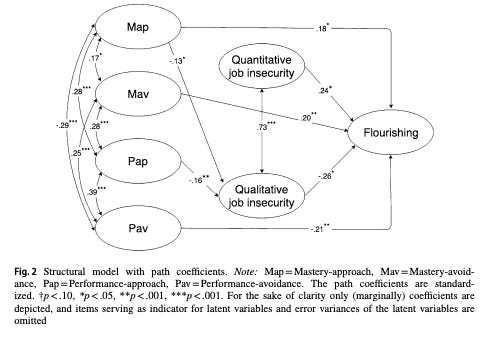
First, it was the qualitative kind that predicted lower flourishing, while fear of losing the job itself did not. Read that in the context of AI. Most employees aren’t only asking whether AI will take their job. They’re asking whether their job will still be something they’re good at, can grow in, and care about. That second question is the one this study ties to lower well-being.
Second, employees oriented toward mastery (learning and building skills) flourished more, even with significant job loss looming, while those focused on avoiding looking incompetent flourished less. Wanting to outperform colleagues had no significant effect either way.
Here’s the part that matters for leaders. The authors argue a mastery orientation can be developed through training, that interventions can shape a team’s mastery climate, and that organizations should reduce qualitative insecurity through job crafting and building career adaptability. In other words, this isn’t a trait you hire for and hope. It’s something you build.
A few caveats: this is one cross-sectional, self-report study, the effects are modest, and participants had opted into career advice. It shows association, not causation. But it lines up with decades of motivation research.
For my I/O nerds out there: here are the correlations van Dam and colleagues found.
Where motivation theory comes in
van Dam’s work comes from achievement goal theory rather than Self-Determination Theory, but the two meet at the same place: competence. Mastery goals are fundamentally about growing competence. In SDT, competence is one of three basic psychological needs (alongside autonomy and relatedness) that fuel high-quality motivation and wellbeing. When competence breaks down, when people don’t believe they can do something well, the result is often amotivation: not just low motivation, but no reason to try at all.
That’s the real risk of rolling out transformation without training. Not just slower adoption, but people who quietly stop trying.
And notice what Coach Aurich’s drill actually does. It doesn’t just build competence. It builds it together, so eleven people know their role when the clock hits zero. That’s competence and relatedness in the same rep.
Meanwhile, L&D budgets are moving the other direction
The Center for Creative Leadership surveyed 325 mid- and senior-level HR and talent leaders in June and July 2025 about leadership development spending under economic pressure. The findings read like a playbook for doing the opposite of what Coach Aurich does.
Everyone agrees it matters. Most will cut it anyway. 82% say leadership development is a competitive advantage in uncertain times, and 84% say it becomes even more critical during disruption. Yet 71% expect to cut those budgets if the economy worsens. Only 2% questioned whether the programs actually work. The cuts are about pressure, not performance.
The cuts land closest to the work. If budgets tighten, 46% would reduce development for individual contributors and 42% for first-level leaders, compared with 30% for executives. By CCL’s math, IC budgets would be cut 42% more than executive budgets, and first-level leader budgets 33% more. Meanwhile, 95% plan to maintain or increase investment in high-potential talent.
The timing couldn’t be worse. The World Economic Forum’s Future of Jobs Report 2025 found employers expect 39% of workers’ core skills to change by 2030, yet organizations are trimming development for the very people whose day-to-day work is about to shift the most.
The drill is being replaced by the portal. In a downturn, 69% would increase digital delivery, 67% would decrease in-person training, and 69% would restrict travel for L&D. The top-prioritized method is online on-demand tools (69%). On-the-job training? Just 33%.
Even CCL, which sells leadership development (worth keeping in mind), concedes in the report that on-demand digital learning can’t fully replicate the peer connection and relationship-building of live learning.
A self-paced module can teach you what a Hail Mary is. It can’t get eleven people to run one in four seconds.
What drilling looks like at work
Bespoke doesn’t have to mean expensive. A few ways to borrow from Aurich:
Rehearse the bad scenarios. Run the “60 seconds, no timeouts” version of your transformation: the AI tool gives a confidently wrong answer to a client, a key system fails at quarter end, a new workflow collides with an old one. Practice the response before it’s live.
Practice as a team. Big Ben works because everyone knows where to be. Cross-functional drills build shared mental models a solo course can’t.
Make mistakes safe in practice. Remember the false start? The guy next to me assumed that player’s season was over. But one player’s mistake didn’t sink the team, because the team had already practiced for worse. That’s the difference between a culture built on not looking bad and one built on getting better. Error management training, which encourages people to make and learn from errors during training, has been shown to improve how well people adapt skills to new situations (Keith & Frese, 2008). That’s a mastery climate in action.
Protect frontline development. The people closest to the work are the ones whose qualitative job insecurity is highest right now.
The bottom line
Investing in L&D will be critical for the future. But sending people to generic training on the basics isn’t enough. The organizations that come out of this transformation ahead will treat training as a strategic advantage: building curricula no one else can replicate, drilling together, and preparing for the moments that matter before those moments arrive.
That false start should have ended the game. It didn’t, because Harvard had already practiced what to do when things went from bad to worse.
Just ask Colgate.
Resources
The game
O’Connell, R. (2026, October 6). The Harvard football coach who hacked the Hail Mary. The Wall Street Journal. wsj.com/sports/football/harvard-coach-andrew-aurich-hail-mary-0fa0e3a9
The research
van Dam, A., Noordzij, G., & Born, M. (2020). Thriving under uncertainty: The effect of achievement goal orientation on job insecurity and flourishing. Social Indicators Research. doi.org/10.1007/s11205-020-02337-4 (open access)
Noordzij, G., van Hooft, E. A., van Mierlo, H., van Dam, A., & Born, M. P. (2013). The effects of a learning goal orientation training on self-regulation: A field experiment among unemployed job seekers. Personnel Psychology, 66, 723–755. doi.org/10.1111/peps.12011
Dragoni, L. (2005). Understanding the emergence of state goal orientation in organizational work groups: The role of leadership and multilevel climate perceptions. Journal of Applied Psychology, 90, 1084–1095. doi.org/10.1037/0021-9010.90.6.1084
Keith, N., & Frese, M. (2008). Effectiveness of error management training: A meta-analysis. Journal of Applied Psychology, 93(1), 59–69. doi.org/10.1037/0021-9010.93.1.59
Ryan, R. M., & Deci, E. L. (2017). Self-determination theory: Basic psychological needs in motivation, development, and wellness. Guilford Press. https://doi.org/10.1521/978.14625/28806
The industry data
Center for Creative Leadership. (n.d.). Staying competitive amid economic uncertainty: Trends shaping leadership development budgets [Survey of 325 HR and talent leaders, conducted June–July 2025]. ccl.org/guides/ld-budgets
World Economic Forum. (2025). The future of jobs report 2025. weforum.org/publications/the-future-of-jobs-report-2025