


If you tuned into my first couple posts, I introduced I/O Psychology in a nutshell, and then did a deeper dive into the origins of Industrial Psychology and its relationship with today’s AI Revolution and some ahas I discovered when first introduced to Organizational Psychology. But another question I had when I first started exploring the field was understanding the difference between I/O Psych, OB (Organizational Behavior) and OD (Organizational Development), and my guess is I’m not alone.
This may be a controversial perspective, and I invite all the I/Os, OB, and OD folks to push back on my POV as the literature is far from definitive on the subject. So here goes:
(I)OP - (Industrial) Organizational Psychology
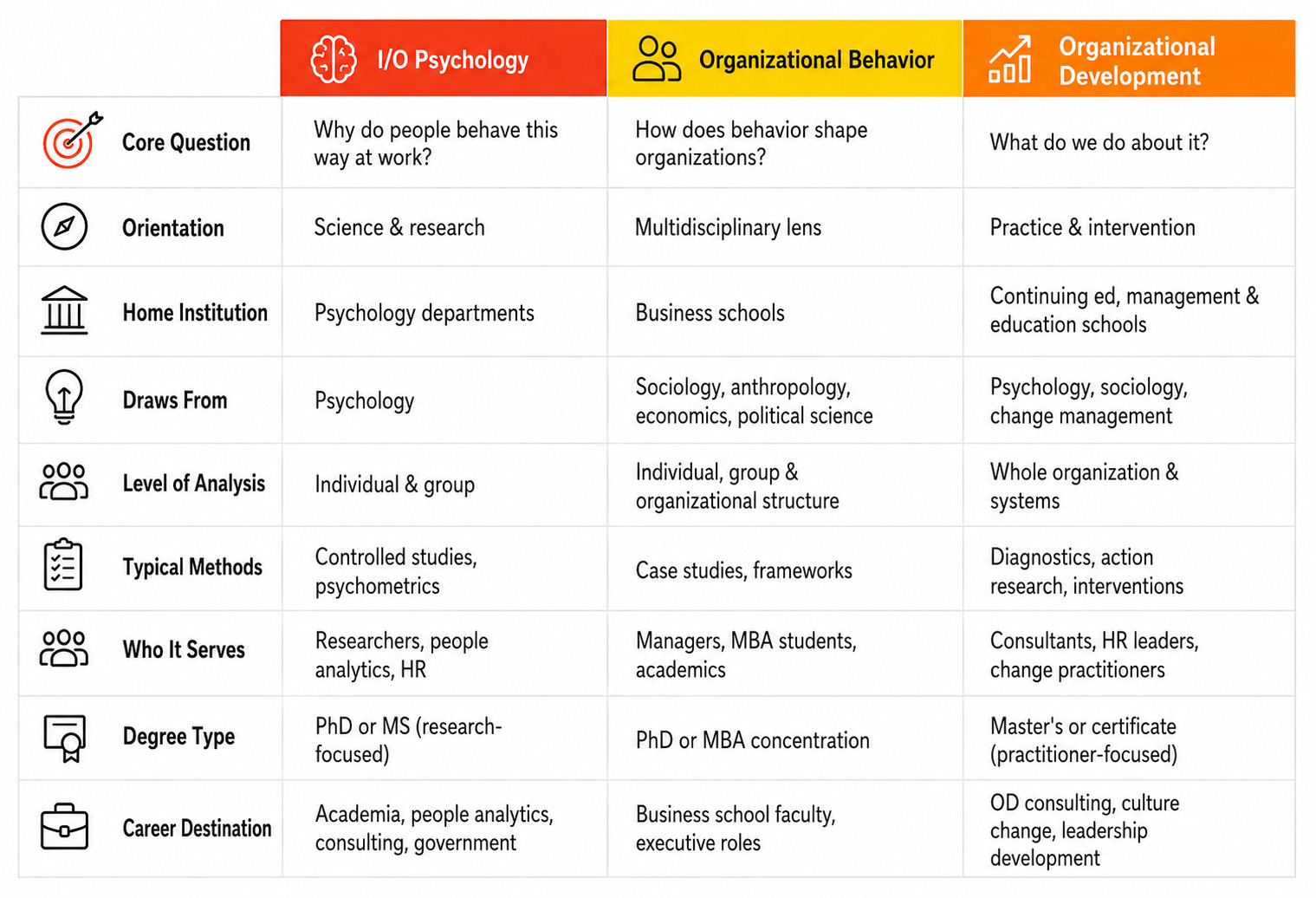
Just to recap what we learned about I/O Psych — it stems from various psychology fields, and at its core it applies the scientific method to the study of people at work. It’s rigorous, evidence-based, and tightly focused on the psychological levers that shape individual and group performance: motivation, cognition, mental ability, wellbeing, and how people adapt (or don’t) to their organizational environment. The key word there is psychological. I/O Psych is always asking: what’s happening inside the person, and how does that interact with work?
Most I/O PhD programs primarily live inside psychology departments and train the researchers and practitioners who generate the field’s evidence base. These programs are rigorous and research-heavy — the kind of training that produces people who go on to publish, consult, or lead people analytics functions.
What’s in a name
For what it’s worth, I’ve never seen I/O Psychology referred to as OP or IOP, it just worked for my headline. Here are the most common ways we see the field referenced in literature (all of which are a mouthful):
I/O Psychology — the most common shorthand in practitioner and popular writing
I-O Psychology — preferred by SIOP officially; the hyphen signals it’s one unified field, not two separate ones bolted together
I/O Psych — casual shorthand, common in academic programs and student contexts (practitioners are frequently referred to as “I/Os”)
Industrial-Organizational Psychology — the full formal name, used in academic writing and official contexts
Industrial/Organizational Psychology — same as above, just with a slash; common in older textbooks
Work Psychology — more common in the UK and Europe; same domain, different branding
Occupational Psychology — the British Psychological Society’s preferred term; heavily used in the UK and Australia
Organizational Psychology — sometimes used as shorthand when the “industrial” half feels dated or when the work skews more toward behavior and culture than selection and assessment
Industrial Psychology — for those purists focused on the job analysis, recruiting, selection, side of the equation
OB - Organizational Behavior
OB, on the other hand, is multidisciplinary. While it also explores many of the themes we study in I/O Psych — motivation, group dynamics, job satisfaction, leadership — it draws from sociology, anthropology, business, and economics too. Think of it as a wider-angle lens on the same subject matter.
The clearest difference I’ve found between my I/O and OB coursework is this: I/O is scientific study-based, while OB is more business-driven. In I/O, you’re generating and testing hypotheses. In OB, you’re learning from real organizational stories and applying frameworks to diagnose what went right or wrong. One is more statistics focused, the other is more field case studies.
OB also tends to operate at more levels simultaneously — it cares as much about org structure, power dynamics, and culture as it does about the individual employee. I/O narrows the frame; OB widens it.
Not coincidentally, the elite OB PhD programs live inside business schools. At the MBA level, OB is almost always a concentration rather than a standalone degree. The home institution tells you a lot: OB is built to serve managers and future faculty, not clinicians or researchers.
OD - Organizational Development
Confused yet? Now lets add Organizational Development to the mix.
If I/O asks why people behave the way they do, and OB asks how behavior shapes organizations, OD asks: what do we do about it?
OD draws its roots from organizational psychology as well as sociology, and change management. Its fundamental premise is that by designing and delivering “interventions” that change social systems, ways of working, and cultures within organizations, it’s possible to both improve their competitiveness and make them better places for people to work.
The term “organizational development” was coined by Douglas McGregor and Richard Beckhard coined in the 1950s while consulting together at General Mills, to describe an innovative bottoms-up change effort that fit no traditional consulting categories. But its intellectual father came earlier: Kurt Lewin, an MIT professor widely recognized as the founding father of OD, worked across organizational psychology, change management, and group dynamics, and in 1944 established the Research Center for Group Dynamics at MIT.
His most enduring contribution? The change management model of “Unfreeze, Change, and Refreeze” — still widely used in today’s business environment. The idea is elegant: you have to loosen the old patterns first, introduce the change, then lock the new ones in. Anyone who has tried to shift a team’s culture mid-quarter knows exactly how true that is.
Fun fact: In the UK there’s a distinction between I/Os and ODs, both using the term psychology.
Occupational Psychologist — protected title, regulated, credentialed, closer in spirit to the American I/O tradition
Business Psychologist — broader, more commercially oriented, unregulated, closer in practice to what a lot of OD consultants do in the US
Where I/O Psych and OB tend to describe and explain, OD intervenes. It’s the field most concerned with transformation — restructuring, culture change, leadership development, team effectiveness, and organizational design. Less lab, more operating table.
OD programs reflect this practitioner bent in where they’re housed — continuing education divisions, management schools, education programs. These programs skew mid-career — the students tend to be HR leaders and consultants, not fresh undergrads. It’s also worth noting that many schools offer OD master’s degrees under different names — Leadership and Change, Organizational Leadership — so finding the right fit is partly about reading past the label to see what’s actually in the curriculum.
A quick detour: what about Organizational Design?
One more distinction worth flagging before we go further: Organizational Design — sometimes also called OD, which doesn’t help anyone — is its own adjacent field. Where OD keeps the engine running, Org Design decides what kind of engine you need in the first place. Think structures, reporting lines, role architecture, spans of control and how work actually flows through a company. It’s a topic worth its own post — and we’ll get there. Because when you start looking at the organizational friction caused by rushed AI deployments, you quickly realize that bad org design decisions are very often the root of the problem. But that’s a thread for another day.
(I)OP vs. OB vs. OD — Okay, But Really
I know. Even with all that, it still sounds like a lot of the same thing. Looking at academic discussion boards, there doesn’t seem to be clearly agreed upon distinctions.
The way I’ve come to think about it: I/O is the science, OB is the business strategy, and OD is the practice.
I/O Psychology gives you a rigorous, peer-reviewed research base. It asks precise psychological questions and demands controlled answers. OB takes that knowledge and combines it with insights from sociology, anthropology, and political science to build a richer, messier, more realistic picture of how organizations actually function. And OD takes all of it and puts it to work — diagnosing organizational friction, designing interventions, and managing change.
Or, as one researcher put it, OB “develops a much bigger canvas” for understanding phenomena like job satisfaction or motivation, while I/O explains them strictly from the angle of human psychology. Neither approach is wrong — they’re just trying to answer different questions.
The boundaries genuinely do collapse in practice. Most OD consultants draw on I/O research. Most OB courses teach I/O findings. And anyone doing serious I/O work ends up bumping into OB concepts constantly. The fields aren’t rivals — they’re layers. And once you see the layers, you start seeing them everywhere.
The reality is there’s no single term that describes the field in general, and no clear definition for any of this, which might explain why the field has such an identity problem. I think it’s time for us to get a branding consultant to come fix it!
Hope you enjoyed If you agree or disagree with this perspective I’d love to know. Please share in the comments.
I’m in a different field - primary care pediatrics (leaving the admin side at the end of the month). Your posts a fascinating and well written. While I do not have a comment specific to the differences and similarities of the fields you are discussing, one thing came to mind with one of the acronyms. When I read “IOP”, I think “Intensive Outpatient Therapy”, which is in the field of psychology, but on an individual level, often related to depression or anxiety treatment. There are just not enough letters in the alphabet to have unique acronyms for everything.
Keep up the great work. I’m looking forward to learning more!