


Updated October 2026: This newsletter is now Second Opinion, published by The Antidotes. The mission hasn’t changed. [Read the announcement.]
I/O psychology is the scientific study of people at work: how to hire, motivate, lead, and organize them so both the people and the business thrive.
Full disclosure: I started pursuing a degree in Industrial-Organizational Psychology before I actually knew what it was. Like many in my cohort, I’d become a fan of Adam Grant, who calls himself an “organizational psychologist” in his books and podcasts. Whatever he was selling, I wanted in.
That curiosity led me to Harvard Extension School, where I’m now neck-deep in research that I believe most business leaders need, and almost none of them have access to. Not because it doesn’t exist, but because it’s buried in academic journals written for academics, full of statistical models and terminology that would make your eyes glaze over before page two.
That’s why I’m here.
I’ve spent over 25 years in consulting, marketing, and product management, and I’ve watched well-intentioned leaders make expensive, avoidable mistakes with their teams, their cultures, and their organizations that the research could have predicted. The layoffs that tank morale. The reorganizations that drive out the best people. The feedback cultures that quietly destroy performance. The evidence is out there. It’s just not getting into the right hands.
So who am I to write about this? At my first Society for Industrial and Organizational Psychology (SIOP) conference, attendees were often asked to identify as either a scientist or a practitioner. At the time, I was neither: a business leader who went back to school because I wanted better answers for leading teams through change. That’s changed. I’ve since co-founded The Antidotes with Danielle Kaufman to put this research to work inside real organizations which is now incubated out of Harvard Innovation Labs.
Putting the I in I/O
Everyone in the I/O field acknowledges the branding problem. Adam Grant typically leaves off the “I” when he describes himself, perhaps because “industrial” sounds arcane to most people. On Brené Brown’s podcast, the two argued that if psychology wants to connect with people, it needs better language: more accessible, more human. I couldn’t agree more. While I/O researchers are busy writing for each other, business leaders are making high-stakes decisions about their people based on gut instinct, outdated frameworks, or the management trend du jour.
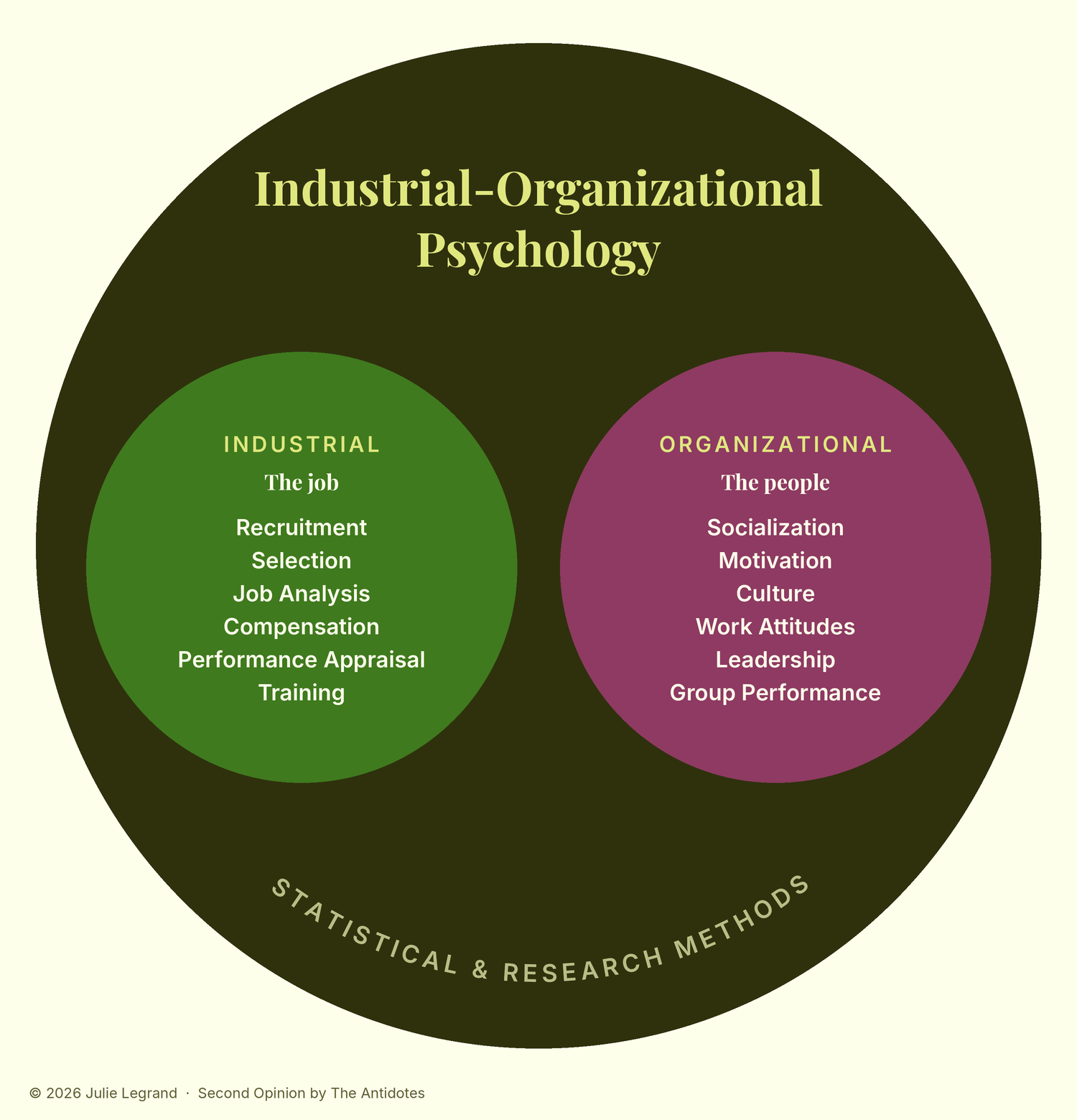
So what exactly is I/O psychology? The “I,” Industrial Psychology, covers job analysis and design, recruitment and selection, performance appraisals, compensation, and training. The “O,” Organizational Psychology, tackles socialization, motivation, leadership, culture, work attitudes, and group performance. It’s all grounded in rigorous research methods. Taken together, it represents decades of evidence about what actually makes organizations, and the people in them, work. The purpose of our work is to ensure employees are treated fairly, jobs are more engaging and satisfying, and ultimately, workers are more productive. In the UK, it’s usually called occupational psychology, or sometimes business psychology.
Boardroom Psychology
I//O psychologists often talk about the “scientist-practitioner gap”: academics produce rigorous research that rarely reaches the HR professionals who could use it. I’d argue that’s not nearly ambitious enough (I said as much in SIOP’s newsletter). We don’t just need to close the gap between scientists and practitioners. We need to close the gap between the science and the boardroom.
That’s the goal of Second Opinion: to take a second look at what’s really going wrong at work, research in hand, and bring the most useful findings to the people who need them most. That means leaders who are responsible for other humans and want to do right by them.
Stick around as I dig into job insecurity, moral injury, creativity, feedback, org design, ambition, and much more. I promise to leave the regression tables out of it. And if you’re one of the many leaders making high-stakes decisions about your people in the name of AI transformation, this is especially for you. The technology may be moving fast, but the humans in your organization are not. I/O psychology offers a rare, evidence-based lens for navigating that gap without leaving your best people behind.
Well done, Julie — really informative and thoughtfully written. Looking forward to reading more.
Very interesting read on IO psychology. Always wondered why it was called Industrial.